Rec Center
What Happens After School in Twin Falls? Not Enough.
TL;DR:
The hours between 3 and 6 p.m. are the highest-risk window for unsupervised youth in America. In Twin Falls, a city of 57,325 residents with no public recreation center, most working parents have three options when school lets out: expensive private programs, informal arrangements with neighbors and relatives, or leaving kids unsupervised. A recreation center with open gym, youth programming, homework space, and supervised drop-in access gives families an affordable, safe, daily-use option that solves a problem every working parent in the Magic Valley already knows they have.
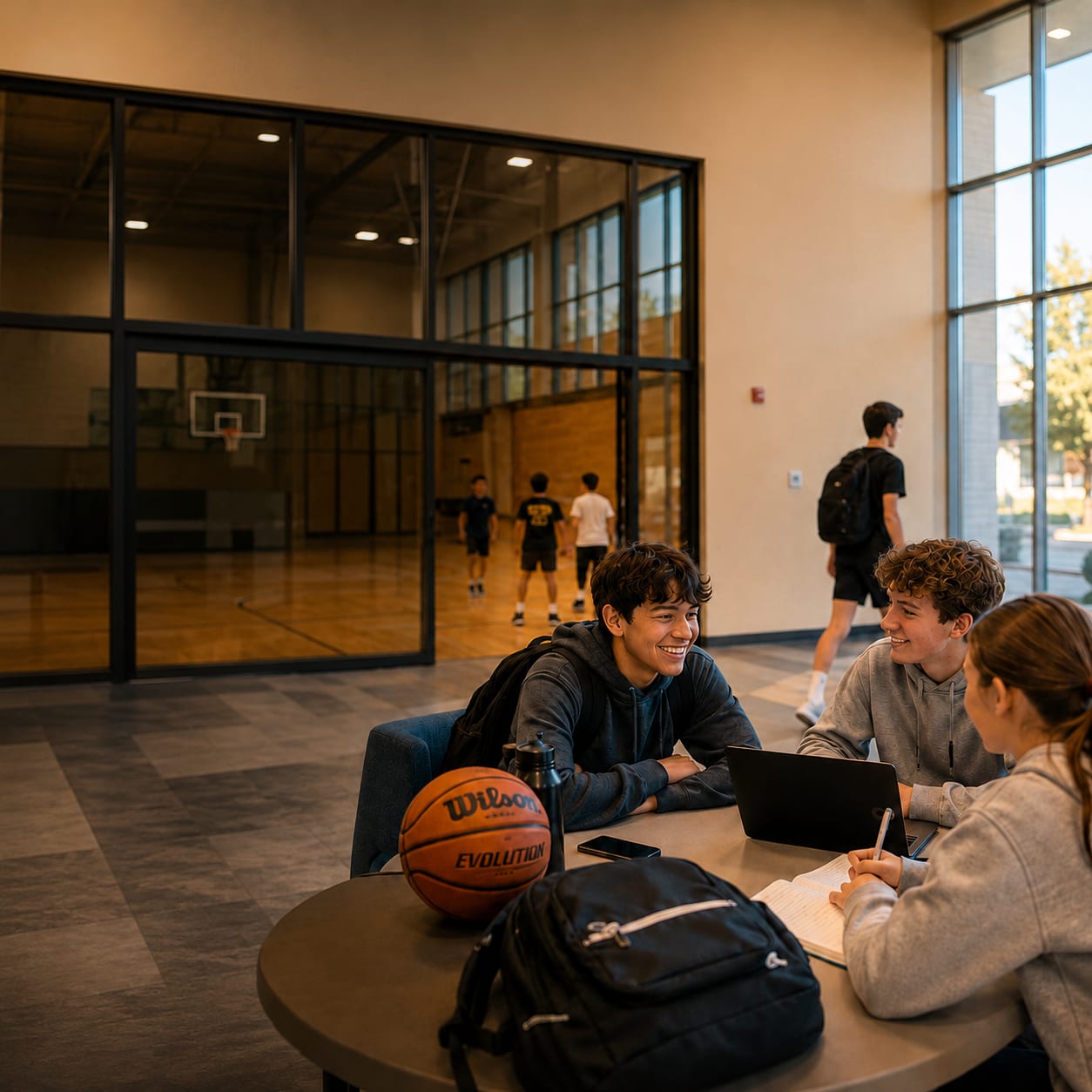
The previous post in this series described what a week at the Twin Falls recreation center could look like. One of the scenes was a sophomore named Marcus, walking to the rec center after school, playing pickup basketball for 90 minutes, and doing homework in the lobby until his mom picked him up at 5:15.
That scene was not filler. It was the single most common daily use case for a community recreation center in every city that has one. The after-school hours are when the building earns its membership base, when parents decide the monthly fee is worth it, and when a rec center stops being a sports facility and becomes essential infrastructure for working families.
In Twin Falls, that infrastructure does not exist.
The 3-to-6 problem
Researchers and youth development professionals call it the "3-to-6 gap." It is the window between school dismissal and when most working parents arrive home. For families with two working adults or a single working parent, these are the hours when children are most likely to be unsupervised.
The Afterschool Alliance has documented that for every child in an after-school program in the United States, roughly three more are waiting for a spot. The demand far outstrips the supply in most communities, and the gap falls hardest on low- and moderate-income families who cannot afford private options.
The consequences of unsupervised after-school hours are not abstract. Research consistently links the 3-to-6 window to higher rates of juvenile crime, substance experimentation, risky behavior, and academic disengagement. The hours are not dangerous because teenagers are inherently reckless. They are dangerous because boredom, unsupervised peer influence, and the absence of structured activity create conditions that predictably lead to worse outcomes.
Twin Falls is not immune to this. Idaho has designated behavioral health as a state public health priority. Youth mental health outcomes in Idaho are among the worst in the nation. The after-school gap is one of the contributing factors, and it is one of the most solvable.
What Twin Falls parents currently do
Talk to any working parent in Twin Falls and the after-school conversation sounds the same.
Some families pay for private after-school programs through churches, private clubs, or tutoring centers. These run $150 to $400 per month per child, depending on the program. For families with two or three kids, that is $300 to $1,200 per month on top of every other expense.
Some families rely on informal arrangements: a grandparent, a neighbor, a rotating cast of other parents who take turns hosting. These work until they do not, and they place a social burden on the families providing free childcare.
Some families leave their kids at home. The child comes home to an empty house, locks the door, and occupies the next three hours alone. For a 15-year-old, this might be fine. For a 10-year-old, it is a daily source of parental anxiety. For an 8-year-old, it is something most parents try to avoid entirely but sometimes cannot.
None of these are solutions. They are workarounds for a problem that a public facility solves structurally.
What a rec center does from 3 to 6 p.m.
A community recreation center does not run a formal "after-school program" the way a private provider does. It does something simpler and more powerful: it opens its doors.
Open gym. The gymnasium courts are available for drop-in basketball, volleyball, and other court sports during afternoon hours. Kids show up, check in with a membership card or student ID, grab a ball, and play. No registration. No fee beyond the family membership. Supervised by facility staff. This is what the previous blog described Marcus doing, and it is the single most common after-school activity at recreation centers nationwide.
Youth activity space. A designated area where kids can sit, do homework, charge their phones, and socialize in a supervised environment. Not a classroom. Not a tutoring center. Just a safe, warm, staffed space where a child can exist between 3 and 6 without being alone.
Drop-in programming. On a rotating schedule, the rec center offers afternoon activities: martial arts classes on Wednesdays, open swim on Tuesdays and Thursdays (if aquatics are included), the climbing wall on Mondays, badminton or table tennis in the multipurpose room on Fridays. Each activity gives kids a reason to show up on a specific day and a skill to develop over time.
The indoor track. Available for walking and running during all open hours. For kids who do not want to play a sport but want to move, the track is there. For kids training for cross country or track and field, it is indoor conditioning space that does not depend on weather.
The fitness center. Teens above a minimum age (typically 14 or 15 at most recreation centers) can access the weight room and cardio equipment during after-school hours, often with an orientation requirement and parental permission form.
None of this requires a dedicated after-school coordinator, a grant application, or a separate program budget. It is the baseline function of a recreation center during afternoon hours: open the building, staff it, and let kids use it.
Why this drives memberships
After-school use is where a recreation center converts from "nice to have" to "we need this." Here is why.
A parent who joins a private gym is paying for their own fitness. A parent who buys a family recreation center membership is paying for their fitness, their kids' after-school supervision, their children's sports access, the family's weekend recreation, and the senior grandparent's morning walk, all on one monthly payment.
That value proposition is why family memberships are the revenue backbone of self-sustaining recreation centers like Nampa's. Parents do not buy the membership because of one activity. They buy it because the combination of after-school access, youth sports, fitness classes, and family recreation makes the monthly cost lower than what they are currently paying for fragmented private alternatives.
After-school use is the daily habit that justifies the monthly payment. A family that uses the rec center three afternoons a week does not cancel their membership. They renew it.
The equity dimension
The income gap in youth sports participation widened to 20.2 percentage points in 2024 according to the Aspen Institute. After-school access follows the same pattern. The families who can least afford private after-school programs are the ones who need supervised options most.
A recreation center with an open-door afternoon policy does not means-test entry. It does not require a scholarship application. It does not put a child through an enrollment process. A kid with a membership card walks in and plays. A kid whose family qualifies for a reduced-rate membership walks in and plays exactly the same way.
That structural equality, where the 10-year-old whose parents earn $40,000 and the 10-year-old whose parents earn $100,000 use the same gym at the same time with the same access, is something private after-school programs cannot replicate. It is what public recreation infrastructure is designed to do.
What this means for the facility's daily rhythm
The capstone blog mapped the rec center's year across twelve months. After-school programming maps its day.
6 a.m. to 8 a.m.: Early-morning fitness crowd. Adults before work. 8 a.m. to 12 p.m.: Senior programming. Fitness classes. Daytime drop-ins. 12 p.m. to 3 p.m.: Lightest hours. Maintenance window. Midday fitness users. 3 p.m. to 6 p.m.: After-school surge. Open gym. Youth programming. Homework space. The building's busiest weekday window by headcount. 6 p.m. to 10 p.m.: Adult leagues. Dodgeball. Pickleball. Open recreation. Family evening use.
The after-school window is not a bonus. It is the peak of the facility's weekday utilization curve. A recreation center that does not serve the 3-to-6 crowd is a recreation center operating below its potential during its highest-demand hours.
Where the conversation stands
A recreation center committee within the Twin Falls Parks and Recreation Department has been studying this question since 2017. In June 2025, the City Council voted to advance the long-stalled feasibility study. Parks and Recreation Director Wendy Davis said the council's vote "breathed a little bit of life into what I thought was a dying initiative."
A grassroots advocacy campaign has proposed naming a potential facility after U.S. Army Specialist Troy Carlin Linden, a soldier with the 54th Engineer Battalion who was killed in action on July 8, 2006, in Ar Ramadi, Iraq. The proposal comes from a Twin Falls resident who served in the same unit.
Closing
Every working parent in Twin Falls knows the 3-to-6 problem. They solve it every day with private programs they can barely afford, informal arrangements they cannot always rely on, or an empty house they wish their child did not come home to.
A recreation center does not solve this problem with a specialized after-school program that requires funding, grants, and enrollment paperwork. It solves it by being open. Courts available. Track available. Homework space available. Staff on site. Doors unlocked from 3 to 6, Monday through Friday, twelve months a year.
That is not a feature of a recreation center. It is the reason most families buy a membership.
Frequently Asked Questions
Does a rec center run a formal after-school program? Most community recreation centers do not operate a formal licensed after-school program. Instead, they provide open access during afternoon hours: open gym, youth activity space, drop-in programming, and supervised common areas. Kids check in with a membership card and use the facility. This model serves more kids at lower cost than a formal program.
How much does private after-school care cost in Twin Falls? Private after-school programs in the Twin Falls area typically cost $150 to $400 per month per child. For families with multiple children, annual costs can reach $3,600 to $14,400. A recreation center family membership covers after-school access for all children at one flat rate.
Is the rec center supervised during after-school hours? Yes. Community recreation centers are staffed during all open hours. Facility staff monitor the gymnasium, common areas, and activity spaces. This is not one-on-one childcare, but it is a supervised public environment where children are visible and accounted for.
What activities are available after school? Typical after-school offerings include open gym (basketball, volleyball), the indoor track, youth martial arts classes, climbing wall access, table tennis, homework and socializing space, and rotating drop-in activities. Specific programming varies by day.
Is Twin Falls actively considering a recreation center? A city committee has been studying the question since 2017. In June 2025, the City Council voted to advance the feasibility process. No specific site, cost, or funding mechanism has been finalized as of this writing.
Where can residents follow the conversation? Twin Falls City Council meetings are open to the public, and the Parks and Recreation Department posts updates on the city's official website. A community advocacy group is also tracking the issue at twinfallsreccenter.com.