Rec Center
Table Tennis Belongs in a Rec Center. Twin Falls Needs One.
TL;DR:
Table tennis is an Olympic sport played by more than 300 million people worldwide. It is also one of the simplest, cheapest, and most inclusive activities a community recreation center can offer. It fits in a multipurpose room, requires a table and two paddles, and welcomes players from age 8 to 80 in the same session. The proposed Twin Falls recreation center includes multipurpose rooms that could host table tennis open play, youth programs, senior recreation, and small community tournaments without taking a single hour of gymnasium time away from basketball, volleyball, or any other court sport.
The recreation center tournament series has covered the sports that fill gymnasiums: basketball, volleyball, wrestling, pickleball, futsal, cheerleading, martial arts, badminton, and dodgeball. Every one of those uses the multi-court gymnasium as its primary space.
Table tennis does not need the gymnasium at all. It needs a multipurpose room, a few tables, and an open evening on the schedule. And in a facility designed to maximize every square foot of usable space, that distinction matters more than it might seem.
The world's most underestimated sport
Table tennis has a perception problem in America, and it is almost identical to badminton's. Most Americans think of it as a basement game played on a warped table during Thanksgiving. The global reality is different.
Table tennis has been an Olympic sport since 1988. It is played competitively in more than 200 countries. The International Table Tennis Federation estimates more than 300 million active players worldwide, making it one of the most participated-in sports on earth. At the competitive level, rallies happen at speeds exceeding 60 miles per hour, reaction times are measured in milliseconds, and matches require a combination of hand-eye coordination, footwork, spin control, and tactical thinking that surprises anyone who has only played casually.
In the United States, table tennis occupies a smaller but real niche. USA Table Tennis, the national governing body and a member of the U.S. Olympic and Paralympic Committee, sanctions tournaments across the country and oversees youth development, collegiate, and adaptive programs. Community recreation centers are among the most common places Americans encounter competitive table tennis for the first time.
Why table tennis is the perfect multipurpose room sport
Every other sport in the Twin Falls tournament series requires the gymnasium. Table tennis is the first activity in the series that operates entirely outside of it, and that is its superpower as a rec center offering.
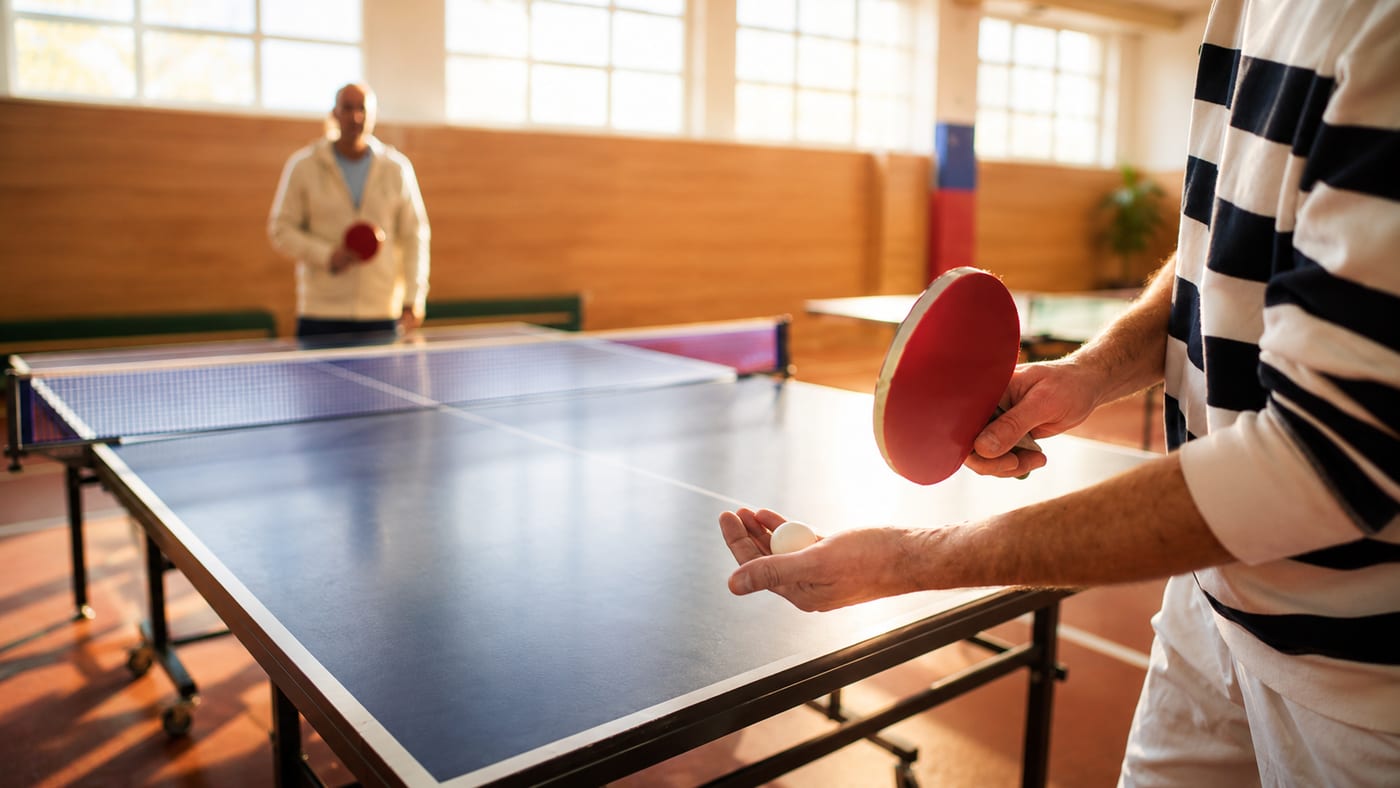
A regulation table tennis table measures 9 feet by 5 feet. With adequate playing space around it, a single table needs roughly 14 by 7 feet of room. A standard multipurpose room in a recreation center can comfortably fit four to six tables simultaneously. The proposed Twin Falls recreation center includes multipurpose rooms and event space that are designed for exactly this kind of flexible programming.
Tables fold and store against a wall when the room is needed for other purposes: meetings, dance classes, birthday parties, community events. They unfold in minutes when it is time for table tennis. No permanent installation. No specialized flooring. No nets to hang or mats to roll out. A table, a net clamp, paddles, and balls. Total equipment cost for a four-table setup is under $3,000, and the tables last for years.
This means table tennis programming runs simultaneously with gymnasium activities rather than competing for the same space. While basketball leagues are on the courts on a Wednesday evening, table tennis open play runs in the multipurpose room down the hall. While a wrestling invitational fills the gym on a Saturday, a table tennis round-robin runs in the adjacent room. The facility serves two completely different communities at the same time without a scheduling conflict.
What table tennis at a rec center looks like
Table tennis programming at a community recreation center follows the same accessible, low-barrier model as badminton and dodgeball. It starts simple and grows with demand.
Open play sessions. The rec center sets up tables on designated evenings or weekend afternoons. Residents drop in, pick up a paddle, and play. No registration, no skill requirement, no partner needed. Regulars emerge quickly. Friendships form across tables. The social dimension of table tennis, standing three feet from another person and competing in rapid-fire rallies, creates connection in a way that solitary gym workouts cannot.
Community tournaments. Once a base of regular players exists, small round-robin or bracket-style tournaments are easy to organize. A Saturday event with 16 to 32 players runs on four tables in a few hours. Singles, doubles, and mixed doubles divisions keep everyone involved. Entry fees are minimal. The atmosphere is competitive but relaxed. These are the kind of low-cost, high-participation community events that fill a rec center's calendar without requiring outside visitors or major production.
Youth programs. Table tennis is one of the most accessible sports for children. The table is scaled to a manageable size. The paddle is light. The ball moves fast enough to be exciting but slow enough (at the recreational level) for developing hand-eye coordination. Youth table tennis clinics teach basic strokes, spin, and rally skills in sessions that double as active recreation and cognitive development.
Senior recreation. This is where table tennis may add the most value to the Twin Falls facility. Table tennis is a low-impact activity that maintains hand-eye coordination, reflexes, reaction time, and mental sharpness in older adults. The physical demands are real but gentle enough for participants with mobility limitations who cannot play court sports. For Twin Falls' 8,967 residents over 65, table tennis offers something that treadmills and stationary bikes do not: competition, social interaction, and fun.
Adaptive and inclusive play. Table tennis is one of the most established adaptive sports in the world. It has been a Paralympic sport since 1960, longer than almost any other adaptive discipline. Players compete in standing and seated (wheelchair) classifications. A rec center table tennis program is inherently accessible to residents with disabilities in a way that most court sports are not, without requiring any modification to the equipment or the rules.
Intergenerational play. Like pickleball, table tennis is one of the few sports where a teenager and a grandparent can play a competitive match against each other and both enjoy it. The skill gap between generations is smaller in table tennis than in most sports because the physical demands are lower and the tactical element is higher. A rec center open play session where a 14-year-old rallies with a 70-year-old is not unusual. It is standard.
The mental health and social connection angle
The mental health case for a recreation center documented that physical activity and social connection are the two factors research most consistently links to better mental health outcomes. Table tennis delivers both in a format that is uniquely accessible.
A table tennis session is inherently social. You cannot play alone. You stand across from another person, make eye contact, react to their decisions, and share moments of surprise, frustration, and laughter in real time. For residents dealing with isolation, loneliness, or the early stages of cognitive decline, that structured social interaction, embedded in a physical activity that sharpens reflexes and concentration, is exactly what the Surgeon General's 2023 advisory called for when it recommended strengthening social infrastructure.
Table tennis does not cure loneliness. But a Tuesday afternoon table tennis session for seniors in a recreation center multipurpose room is the kind of low-barrier, high-connection activity that gives isolated residents a reason to leave the house, a place to go, and people who notice if they do not show up next week.
What this adds to the facility calendar
The cumulative argument of the tournament series has been that a single facility serves basketball one weekend, volleyball the next, wrestling in January, futsal on weeknights, pickleball year-round, cheer competitions on Saturdays, martial arts classes on weekday evenings, and dodgeball open play on Tuesday nights.
Table tennis adds another activity that runs alongside all of them without ever conflicting. While the gymnasium hosts its schedule of court sports and events, the multipurpose room hosts table tennis. Two different spaces, two different communities, operating at the same time.
For a facility whose long-term financial sustainability depends on maximizing utilization across every room, every hour, and every day, table tennis is one of the simplest ways to ensure the multipurpose rooms are generating activity and serving residents during hours when they might otherwise sit empty.
Where the conversation stands
A recreation center committee within the Twin Falls Parks and Recreation Department has been studying this question since 2017. In June 2025, the City Council voted to advance the long-stalled feasibility study. Parks and Recreation Director Wendy Davis said the council's vote "breathed a little bit of life into what I thought was a dying initiative."
A grassroots advocacy campaign has proposed naming a potential facility after U.S. Army Specialist Troy Carlin Linden, a soldier with the 54th Engineer Battalion who was killed in action on July 8, 2006, in Ar Ramadi, Iraq. The proposal comes from a Twin Falls resident who served in the same unit.
Closing
Table tennis is an Olympic sport, a Paralympic sport, and one of the most played activities on the planet. It is also one of the cheapest, simplest, and most inclusive things a recreation center can offer.
It does not need the gymnasium. It does not need specialized equipment. It does not need a travel circuit or an economic impact study. It needs a multipurpose room, a few folding tables, and a community willing to pick up a paddle.
The proposed Twin Falls recreation center includes the rooms. The sport includes everyone from 8 to 80, standing or seated, beginner or advanced. And unlike every other activity in this series, table tennis runs without ever competing for a single hour of gym time.
Some sports justify themselves with data. Table tennis justifies itself with a paddle and an open door.
Frequently Asked Questions
Is table tennis a real competitive sport? Yes. It has been an Olympic sport since 1988 and a Paralympic sport since 1960. More than 300 million people play worldwide. USA Table Tennis, a member of the U.S. Olympic and Paralympic Committee, sanctions tournaments and oversees competitive programs across the country.
Does table tennis need the gymnasium? No. Table tennis runs entirely in multipurpose rooms, which means it operates alongside gymnasium sports without scheduling conflicts. Four to six tables fit in a standard multipurpose room. Tables fold and store when the room is needed for other uses.
Who plays table tennis at a rec center? Everyone. Youth developing hand-eye coordination. Adults looking for a social competitive outlet. Seniors maintaining reflexes and mental sharpness. Wheelchair users in one of the oldest and most established adaptive sports. Families playing across generations.
How much does it cost to set up? A four-table setup (tables, nets, paddles, balls) costs under $3,000 total. Tables last for years. Replacement paddles and balls are minimal ongoing costs. It is one of the lowest-overhead activities a rec center can offer.
Is Twin Falls actively considering a recreation center? A city committee has been studying the question since 2017. In June 2025, the City Council voted to advance the feasibility process. No specific site, cost, or funding mechanism has been finalized as of this writing.
Where can residents follow the conversation? Twin Falls City Council meetings are open to the public, and the Parks and Recreation Department posts updates on the city's official website. A community advocacy group is also tracking the issue at twinfallsreccenter.com.