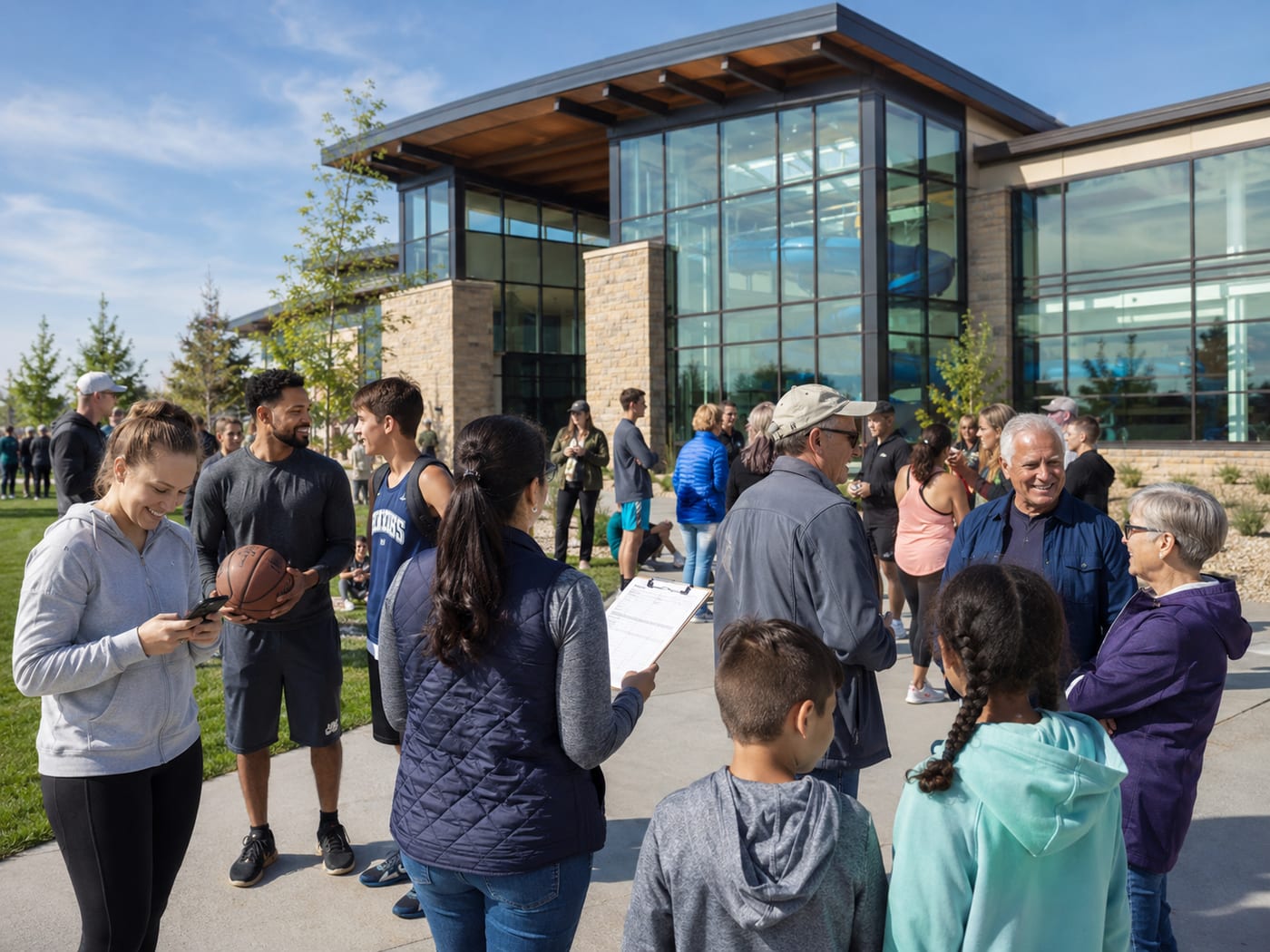
Rec Center
Five Things Twin Falls Residents Get Wrong About Recreation Centers
TL;DR:
A handful of assumptions about community recreation centers have shaped how Twin Falls residents think about the ongoing conversation. Some of those assumptions hold up. Several do not. This post examines five of the most common objections, measures each one against published research and documented Idaho examples, and lets readers draw their own conclusions.
Twin Falls is in the middle of a municipal conversation about whether to build a public recreation center. That conversation has been going on, in one form or another, since 2017. Along the way, a set of assumptions about what recreation centers are, what they cost, and whether Twin Falls needs one has taken hold in the community.
Some of those assumptions are reasonable. Others are not supported by the data. This post looks at five of the most common ones and holds each up to what the research and the public record actually show.
1. A recreation center is a luxury, not a necessity.
This is the most common objection, and it sounds reasonable on the surface. Twin Falls has roads to maintain, schools to fund, and infrastructure to manage. A recreation center, the argument goes, is a nice-to-have that belongs further down the priority list.
The difficulty with this framing is that public health researchers do not classify recreation access as a luxury. They classify it as infrastructure.
The CDC reports that inadequate physical activity is associated with $192 billion in annual U.S. healthcare costs. Physical inactivity contributes to 1 in 10 premature deaths in the United States, and the agency estimates that roughly 110,000 deaths per year could be prevented if adults added just 10 minutes of moderate-to-vigorous activity per day.
For older adults specifically, the numbers are sharper. The CDC has documented that 4 in 5 of the most costly chronic conditions among adults 50 and older can be prevented or managed with regular physical activity. Non-institutionalized adults in that age group spend $860 billion annually on healthcare nationally.
Idaho is not insulated from these trends. According to the Idaho Department of Health and Welfare, the percentage of Idaho adults with obesity rose from 20.5 percent in 2001 to 31.6 percent in 2021. Among Idaho high school students, 28.1 percent described themselves as overweight or obese that same year.
County Health Rankings and Roadmaps, a program of the University of Wisconsin Population Health Institute supported by the Robert Wood Johnson Foundation, rates community fitness programs as having "strong evidence" for increasing physical activity and improving physical fitness among participating adults and older adults.
A recreation center is a fitness facility. It is also, according to the research, a piece of public health infrastructure. Whether Twin Falls treats it as one or the other shapes the entire conversation.
2. Nobody will actually use it.
The concern is that a new facility draws crowds for a few months and then sits half-empty. It has happened in some cities. But the question for Twin Falls is whether the local demand data supports that fear.
Twin Falls has roughly 57,325 residents as of 2026. The city pool, built in the 1980s, serves approximately 60,000 users per year, which means the city's single major aquatic facility is already processing a volume of visits roughly equal to the entire population annually.
Jerome, with approximately 13,000 residents, operates a 32,000-square-foot recreation center with a pool, basketball courts, indoor track, group fitness classes, and youth and adult programming. It is open from 5 a.m. to 9 p.m. on most weekdays. Burley, at roughly 10,000 residents, has comparable facilities. Twin Falls, at more than four times Jerome's size, has none.
The NRPA's 2025 Engagement With Parks Report found that an estimated 227 million American adults visited a local park or recreation facility in 2025. A 2019 NRPA Park Pulse survey found that 91 percent of Americans agree that easy access to low- or no-cost fitness and educational opportunities at local recreation or community centers enhances their community.
The demand question in Twin Falls is not theoretical. The city pool's usage numbers, the existence of functioning facilities in smaller neighboring cities, and national survey data all point in the same direction.
3. It will cost too much and never pay for itself.
This is the objection that deserves the most careful handling, because the cost is real. A recreation facility scaled to Twin Falls would likely cost tens of millions of dollars to build. The campaign's own estimates place the figure in the range of $45 million to $65 million. Nobody should pretend that is a small number.
But cost is not the same as net cost, and the framing matters.
On the economic side, the NRPA's 2023 Economic Impact of Local Parks report found that local park and recreation agency operations and capital spending generated more than $201 billion in economic activity and supported roughly 1.1 million jobs nationally in 2021. That includes direct spending, indirect effects, and induced economic activity at the state level.
On the healthcare side, the CDC-affiliated research is striking. A University of Georgia and CDC study published in the American Journal for Health Promotion found that physical inactivity accounts for $192 billion in annual U.S. healthcare expenditures. Community-level facilities that increase physical activity reduce the per-capita share of that burden over time.
On the operational side, Idaho has a working example. Nampa's recreation center, which opened in 1994, has operated at 100 percent user-funded self-sufficiency for more than thirty years. Membership fees, program revenue, and facility rentals cover all operating costs. The facility carries roughly $3 million in reserves and has required zero taxpayer subsidy since its debt was paid off in 2003, nine years ahead of schedule.
No one should promise that a Twin Falls recreation center will be free to build or run. But framing it as pure cost ignores the economic activity, the healthcare offset, and the operational revenue that comparable facilities have documented for decades.
4. We already have enough options in Twin Falls.
Twin Falls has private gyms, school facilities, and seasonal outdoor parks. The question is whether those options serve the same function as a public recreation center. A few honest distinctions are worth drawing.
Private gyms serve fitness well, and several in Twin Falls offer quality equipment and programming. What they are not structured to do is provide universal-access pricing, senior wellness programming at scale, youth leagues, aquatics, tournament hosting, multipurpose community space, or childcare drop-in services. These are not criticisms of private gyms. They are descriptions of a different service model.
School facilities serve students during school hours and have limited public availability outside of that. They are not designed as community-access infrastructure.
Outdoor parks are valuable, but they are seasonal. In the Magic Valley, where cold weather limits outdoor recreation from roughly November through March, the absence of indoor recreation space creates a five-month gap in consistent physical activity for many residents, particularly children and seniors.
The CDC's Preventing Chronic Disease journal has documented that access to well-maintained recreational facilities is associated with increased physical activity, reduced obesity, and improved mental health outcomes. The County Health Rankings program rates improving access to places for physical activity as a strategy with "strong evidence" for increasing physical activity in urban, rural, and suburban areas.
The gap in Twin Falls is not effort on the part of residents or the quality of existing private options. It is the absence of public recreation infrastructure that serves the full population across all seasons.
5. The city is not seriously considering this.
Some residents assume the recreation center conversation is driven entirely by outside advocates and has no traction inside city government. The public record tells a different story.
A dedicated recreation center committee within the Twin Falls Parks and Recreation Department has been studying the question since 2017. In June 2025, the Twin Falls City Council voted to advance the long-stalled feasibility study, directing the committee to identify a potential property and return with firmer numbers.
Parks and Recreation Director Wendy Davis, speaking to KIVI-TV about the council's vote, said it "breathed a little bit of life into what I thought was a dying initiative."
Meanwhile, the city is actively investing in the recreation infrastructure it does have. The city pool is in the middle of a $2 million-plus renovation expected to finish in mid-2026, a project that reflects both the facility's age (built in the 1980s) and the volume of demand it handles at 60,000 annual users.
Community advocacy exists alongside this process. A grassroots campaign has independently built a feasibility study, collected petition signatures, and proposed naming the facility after U.S. Army Specialist Troy Carlin Linden, a soldier with the 54th Engineer Battalion who was killed in action on July 8, 2006, in Ar Ramadi, Iraq. The 20th anniversary of his death coincides with the campaign's target date for a city council presentation.
The conversation is real, it is happening at the city level, and it is further along than many residents realize.
Closing
None of these myths are unreasonable starting points. It makes sense to ask whether a recreation center is a luxury, whether it will be used, whether it will pay for itself, whether existing options are enough, and whether the city is serious about it. Those are the right questions.
What the research and the public record suggest is that the answers to most of them are more favorable than the assumptions. The CDC, the NRPA, Idaho's own health data, and the documented track records of comparable Idaho cities all point toward recreation infrastructure as a measurable public health investment, not a civic amenity.
Whether Twin Falls acts on that evidence is a decision for the council and the residents who will weigh in over the coming year. The myths, at least, deserve to be measured against facts before they shape that decision.
Frequently Asked Questions
Is there actual research showing recreation centers improve public health? Yes. The CDC reports that physical inactivity is associated with $192 billion in annual U.S. healthcare costs and contributes to 1 in 10 premature deaths. County Health Rankings and Roadmaps, supported by the Robert Wood Johnson Foundation, rates community fitness programs and access to places for physical activity as strategies with "strong evidence" for increasing physical activity and improving health outcomes.
How does Idaho compare to the rest of the country on physical activity and obesity? Idaho's adult obesity rate rose from 20.5 percent in 2001 to 31.6 percent in 2021, according to the Idaho Department of Health and Welfare. Among Idaho high school students, 28.1 percent described themselves as overweight or obese in 2021. While Idaho remains below the national median for adult obesity, the trend line has been rising steadily for two decades.
Do recreation centers actually sustain themselves financially? Some do. Nampa's recreation center in Idaho has operated at 100 percent user-funded self-sufficiency for more than thirty years. Its operating costs are covered entirely by membership fees, program revenue, and facility rentals, with no taxpayer subsidy. Not every facility achieves this, but the Nampa model demonstrates it is possible in an Idaho city.
What cities near Twin Falls already have recreation centers? Jerome (approximately 13,000 residents) operates a 32,000-square-foot recreation center with a pool, courts, indoor track, and programming. Burley (approximately 10,000 residents) has comparable facilities. Nampa (approximately 110,000 residents) operates a 140,000-square-foot facility that has been self-sustaining since 1994.
Is Twin Falls actually planning a recreation center? A city committee has been studying the question since 2017. In June 2025, the City Council voted to advance the feasibility process by directing the committee to identify a property and return with firmer numbers. No specific site, cost, or funding mechanism has been finalized as of this writing.
Where can residents follow the conversation? Twin Falls City Council meetings are open to the public, and the Parks and Recreation Department posts updates on the city's official website. A community advocacy group is also tracking the issue at twinfallsreccenter.com.