Rec Center
The Hidden Cost of Not Having a Rec Center: What Twin Falls Families Are Already Paying
TL;DR:
Most of the conversation around public recreation focuses on what it would cost to build. That frames the question incompletely. Twin Falls families are already paying for recreation, just in a scattered way: private gym memberships, youth sports registration, travel to tournaments, swim lessons, and equipment. National data shows the average American family now spends nearly $1,500 per child per year on sports alone, not counting adult fitness. The real question is not whether a community pays for recreation. It is how.
Conversations about public recreation centers tend to start in one place: how much will it cost to build. That is a reasonable question, and eventually it has to be answered. But it is incomplete on its own, because it treats the baseline as zero. It assumes that without a rec center, residents are not paying for recreation at all.
They are. They just are not paying the city.
In 2026, Twin Falls families spend meaningful portions of their annual household budget on recreation through a patchwork of private providers. Gym memberships, youth sports registration, swim lessons, tournament entry fees, travel to competitions, uniforms, equipment, and private coaching. None of these costs show up on a ballot. None of them appear in a city budget. But they show up in household checking accounts, month after month.
This post looks at what recreation actually costs an average family in a city like Twin Falls, based on national research and publicly available Idaho benchmarks. The picture that emerges reframes the funding question in a useful way.
The sticker shock most people have not added up
The Aspen Institute's State of Play 2025 report, the most comprehensive annual survey of youth sports costs in the United States, found that the average American family spent $1,016 on one child's primary sport in 2024. That is a 46 percent increase since 2019, roughly twice the general rate of inflation over the same period. When a family's child plays a secondary sport, the report finds average annual spending climbs to about $1,500 per child.
The costs vary by sport. According to data compiled in the same report, soccer families averaged $1,188 per year per child. Basketball families averaged $1,002. Baseball, typically the most expensive of the three most-played sports, averaged $714 in registration alone but significantly more when travel and equipment are included. Hockey, at roughly $2,583 per year, was the most expensive of the sports surveyed.
For the roughly 17 percent of American kids who play on club or travel teams, the numbers rise further. Annual costs of $2,000 to $20,000 per child are typical, depending on the sport and the level of competition.
Adult fitness adds another layer. The Health and Fitness Association's 2024 U.S. Health and Fitness Consumer Report found that the average American paid $65 per month in gym membership dues in 2023, roughly $780 per adult per year. That figure skews higher in markets with strong premium chains and lower in markets dominated by budget gyms, but the national midpoint is consistent.
None of these figures is a scandal. They are simply what a recreation-engaged family pays when recreation is organized privately. The relevant observation is that they add up, and they add up outside of any civic conversation.
What a typical Twin Falls family is actually paying
Translate the national numbers into a household scene, and the picture becomes concrete.
Consider a median-income Twin Falls family of four. Two working adults, two school-age kids, and a median household income of roughly $61,205 that is in line with the Idaho state average.
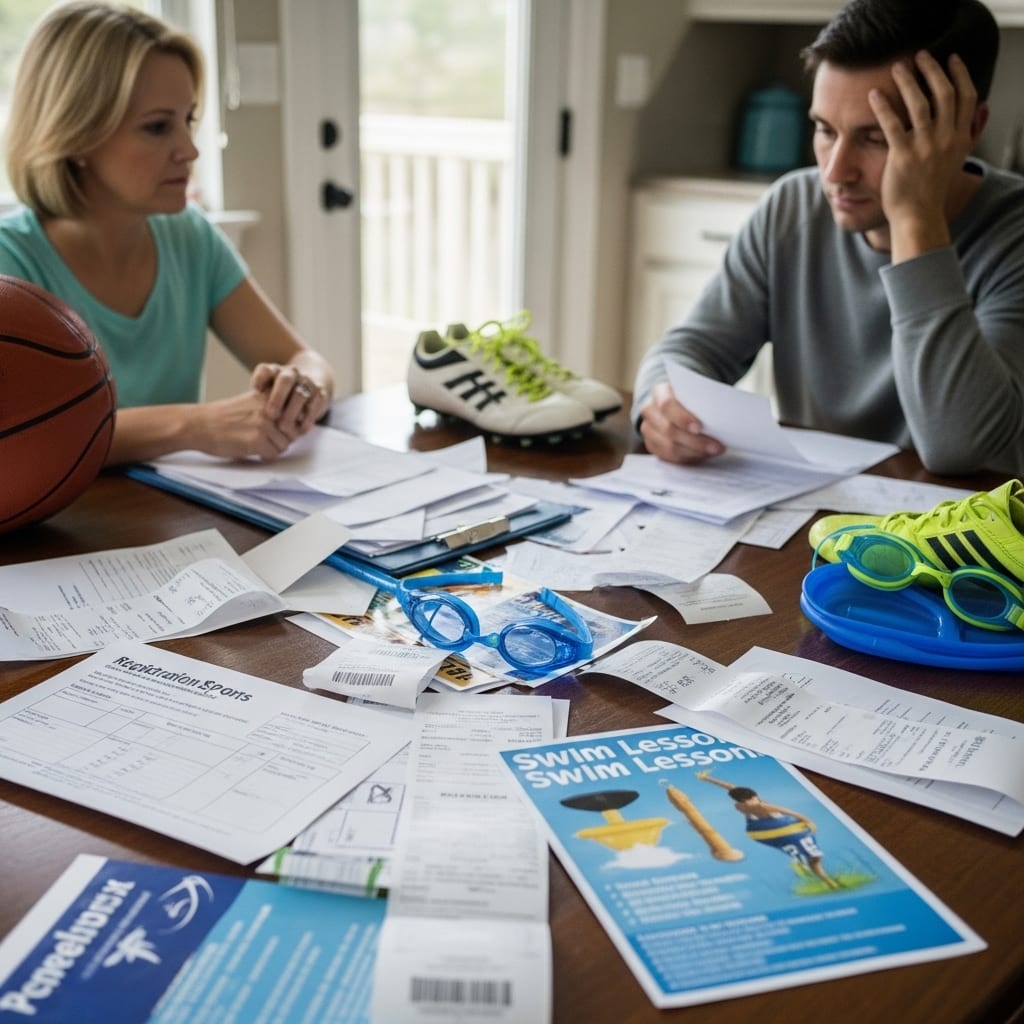
Two adult gym memberships at national averages run roughly $1,560 per year combined. One child in community-level youth soccer or basketball runs roughly $1,000 to $1,200, based on the Aspen data. A second child in private or club swim lessons can run $800 to $1,200 annually. Add equipment, uniforms, seasonal tournament fees, and modest travel, and another $400 to $1,000 appears on the running tab.
The total: roughly $3,700 to $4,900 a year, conservatively, for a family with moderate engagement in recreation.
That is not a wealthy family's budget. That is what a typical Twin Falls household with two kids in sports and two adults in any kind of fitness routine is spending in 2026, if it wants to participate in American recreation at all. And it is what that family spends without a public recreation option in town.
The strain is documented. A 2025 New York Life survey found that 25 percent of youth sports parents have pulled from savings or emergency funds to cover sports costs, and 76 percent have taken some action to manage travel sports expenses. This is not a fringe phenomenon. It is the norm.
The fragmentation tax
The most important thing about this spending pattern is that it is fragmented. A family is not writing one check to one provider. They are writing many checks to many providers, each one priced independently, each one with its own overhead, its own schedule, its own driving directions.
You pay one gym for adult cardio. You pay a separate club for your child's soccer. You pay for another program for swim lessons. You pay a tournament organizer in Boise. You pay for a hotel in Idaho Falls. You buy cleats at one store, a swimsuit at another, and a mouthguard at a pharmacy.
Each fragment is priced for profit, not access. Each one adds overhead, scheduling complexity, driving time, and the quiet mental load of coordinating it all.
A public recreation center does not eliminate recreation costs. It consolidates them. The same family that is paying $3,700 scattered across six private providers can typically pay a fraction of that for a single membership that covers most of the same activities.
Nampa's recreation center, which has operated continuously since 1994, offers a useful benchmark. The youth membership currently runs $33 per month, roughly $396 per year. The family membership, per the Nampa Parks and Recreation Department, covers the spouse and all dependent children under one flat rate, regardless of how many kids are in the household. That pricing model, a household paying once for comprehensive access, is what public recreation is built to do.
The costs that do not show up on receipts
Not every cost is measured in dollars. Some of the highest costs of living without public recreation infrastructure are invisible in a budget but visible in a calendar.
Driving time. Twin Falls families who want access to a pool, indoor track, or group fitness classes frequently drive to Jerome, roughly ten miles away, or farther. Over a year, repeated trips add up to hundreds of hours of car time and several hundred dollars in fuel. That cost belongs in the comparison, even if it does not show up on any invoice.
Winter inactivity. In the Magic Valley, outdoor play is effectively limited from November through March. Without an indoor recreation space, many families simply reduce active recreation for five months of the year. The consequences, documented in Aspen Institute research, are especially significant for kids. Children who lose consistent access to organized movement during the winter months often do not return to previous activity levels in the spring.
The access gap. Perhaps the highest hidden cost is the one borne by families who simply cannot afford the private system at all. National data shows the gap between high-income and low-income kids' regular sports participation widened to 20.2 percentage points in 2024, up from 13.6 in 2012. That gap is not a market failure. It is a direct consequence of privatized recreation. Public rec centers are one of the few proven interventions that narrow it.
What this reframing means
The question "Can Twin Falls afford a recreation center?" is usually asked as if the alternative is free. It is not. The alternative is what residents are already doing, which is paying significant amounts to a fragmented web of private providers, absorbing substantial driving and time costs, losing several months of consistent winter activity, and accepting that some families will simply be priced out of recreation altogether.
Any public recreation center Twin Falls considers would need to be funded. That cost is real and worth examining carefully. But the cost-benefit comparison is more useful when the baseline includes what the current arrangement is already costing households.
That comparison has been run in cities not far from Twin Falls. Nampa's recreation center, according to the city's own published history, has operated at 100 percent user-funded self-sufficiency for more than thirty years. Families there pay a consolidated fee for access that would cost several times more through scattered private alternatives. The model works, and it has worked for decades.
No specific plan has been adopted for Twin Falls. The city committee studying the question is still in the feasibility stage. But the framing residents bring to the conversation matters. A conversation that starts from "how much would this cost taxpayers" will reach a different conclusion than one that starts from "how much are households already paying, and what are they getting for it."
Closing
Recreation is often described as an amenity, something a city chooses to provide or not. The framing is misleading. Residents of every city recreate. The question every community answers, consciously or not, is how that recreation is organized and who bears what share of the cost.
In Twin Falls, the current answer is private, fragmented, and quietly expensive. Whether the city's ongoing conversation produces a different answer is a decision for the council and the residents who weigh in over the coming year or two. The cost-benefit math, whatever it ultimately produces, is more complete when the baseline is honestly accounted for.
Those are numbers worth looking at before the decision gets made.
Frequently Asked Questions
How much does the average American family really spend on recreation each year? According to the Aspen Institute's State of Play 2025 report, the average U.S. family spent $1,016 on one child's primary sport in 2024, rising to roughly $1,500 per child when secondary sports are included. Add adult gym memberships, which average around $65 per person per month nationally, and a two-adult, two-child household engaged in moderate recreation can easily spend $3,000 to $5,000 a year without any public facility available.
Why are youth sports getting so expensive? Costs have risen 46 percent since 2019, well ahead of general inflation. The main drivers are higher registration fees, more travel, privatized coaching, the growth of club and travel teams, and the corresponding decline of community-based recreation leagues. Baseball, soccer, and basketball have all seen significant cost increases over the past five years.
Would a public rec center actually be cheaper for families? Comparable Idaho examples suggest yes. Nampa's youth membership currently runs around $33 per month, roughly $396 a year. The family membership covers a spouse and all dependent children at one flat rate, regardless of how many kids. That consolidation typically saves a recreation-engaged family several thousand dollars a year compared to scattered private spending.
Doesn't a public rec center also cost money to build and operate? Yes. Construction and operation are real costs that have to be accounted for. What is often missed in public discussion is that these costs are offset by user revenue and replace a pattern of private household spending that is already happening. Nampa's recreation center has operated without taxpayer subsidy for more than thirty years.
What about families who cannot afford either option? This is where public recreation makes the biggest difference. Private recreation has grown increasingly inaccessible to low- and moderate-income families. The national income gap in regular youth sports participation has widened meaningfully since 2012. Public recreation centers are among the few infrastructures that narrow that gap, because they are priced for access rather than profit.
Is Twin Falls actively considering a rec center? A city committee has been studying the question since 2017. In June 2025, the City Council voted to advance the feasibility process. No specific plan, site, or funding mechanism has been adopted as of this writing.
Where can residents follow the conversation? Twin Falls City Council meetings are open to the public, and the Parks and Recreation Department posts updates on the city's official website. A community advocacy group is also tracking the issue at twinfallsreccenter.com.