Rec Center
The Rec Center Conversation Nobody in Twin Falls Is Having: Disability Access
TL;DR:
More than 1 in 4 American adults live with a disability. In Twin Falls, that translates to an estimated 7,700 or more residents. Nearly half of adults with disabilities get no aerobic physical activity, and inactive adults with disabilities are 50 percent more likely to develop chronic disease. Public recreation centers are uniquely positioned to address this because they are required to meet ADA accessibility standards and can offer adaptive programming that private gyms do not. Salt Lake County, Portland, and Philadelphia all run adaptive recreation through their public facilities. Twin Falls has no comparable infrastructure.
The conversation about a recreation center in Twin Falls has covered community health, family spending, youth sports, senior wellness, economic impact, seasonal infrastructure, and mental health. Each of those arguments has a documented evidence base. But there is a population that has been almost entirely absent from the discussion, and it is not a small one.
Roughly 1 in 4 American adults lives with a functional disability. Applied to Twin Falls, that is thousands of residents for whom the recreation question is not about convenience or amenities. It is about whether the city has any public infrastructure designed to include them at all.
How common disability actually is
The numbers are larger than most people assume. The CDC's Disability and Health Data System, based on 2022 Behavioral Risk Factor Surveillance System data, found that more than 1 in 4 U.S. adults, approximately 70 million people, reported having some type of functional disability. That includes difficulty with mobility, cognition, hearing, vision, self-care, or independent living.
The U.S. Census Bureau's American Community Survey provides a somewhat lower estimate at 13.5 percent of the total population, reflecting differences in survey methodology. Either way, disability is one of the most common health-related experiences in American life.
Prevalence rises sharply with age. Among adults 50 to 59, about 14.5 percent report a disability. Among those 60 to 64, nearly 1 in 5. Among adults 65 and older, 43.9 percent report a disability, making it the age group with the highest prevalence by a wide margin.
Applied to Twin Falls, a city of 57,325 residents with roughly 8,967 over age 65, a conservative estimate using ACS data suggests approximately 7,700 residents live with some form of disability. Using the CDC's BRFSS rate, the number is significantly higher. These are not edge cases. They are neighbors, family members, coworkers, and community members who currently have no public recreation facility designed to serve them.
The physical activity gap for people with disabilities
The CDC has documented a stark disparity in physical activity between adults with and without disabilities. According to a CDC Vital Signs report, nearly half of adults with disabilities get no aerobic physical activity at all. Among those who are inactive, the health consequences are measurable: inactive adults with disabilities were 50 percent more likely to report at least one chronic disease than active adults with disabilities.
The broader health disparities are significant. The same CDC data shows that adults with disabilities are three times more likely to have heart disease, stroke, diabetes, or cancer than adults without disabilities.
The CDC also found that adults with disabilities were 82 percent more likely to be physically active if their doctor recommended it. The barrier, in many cases, is not motivation. It is access. Adults with disabilities report more environmental barriers to physical activity than those without disabilities, including fewer accessible sidewalks, fewer transportation options, and fewer facilities designed to accommodate their needs.
The CDC's Physical Activity Guidelines state clearly that regular physical activity provides important health benefits for people with chronic conditions and disabilities, including improved cardiovascular health, muscle fitness, brain health, and support for daily living activities and independence. The guidelines apply to people with multiple sclerosis, Parkinson's disease, spinal cord injury, stroke, type 2 diabetes, dementia, and cancer, among other conditions.
The research does not say people with disabilities cannot be active. It says they often cannot find places that let them.
What private gyms are not built to provide
Private fitness facilities in Twin Falls serve their members well for individual exercise. What they are not structured to do, and are not required to do, is provide adaptive recreation programming for people with physical, developmental, or intellectual disabilities.
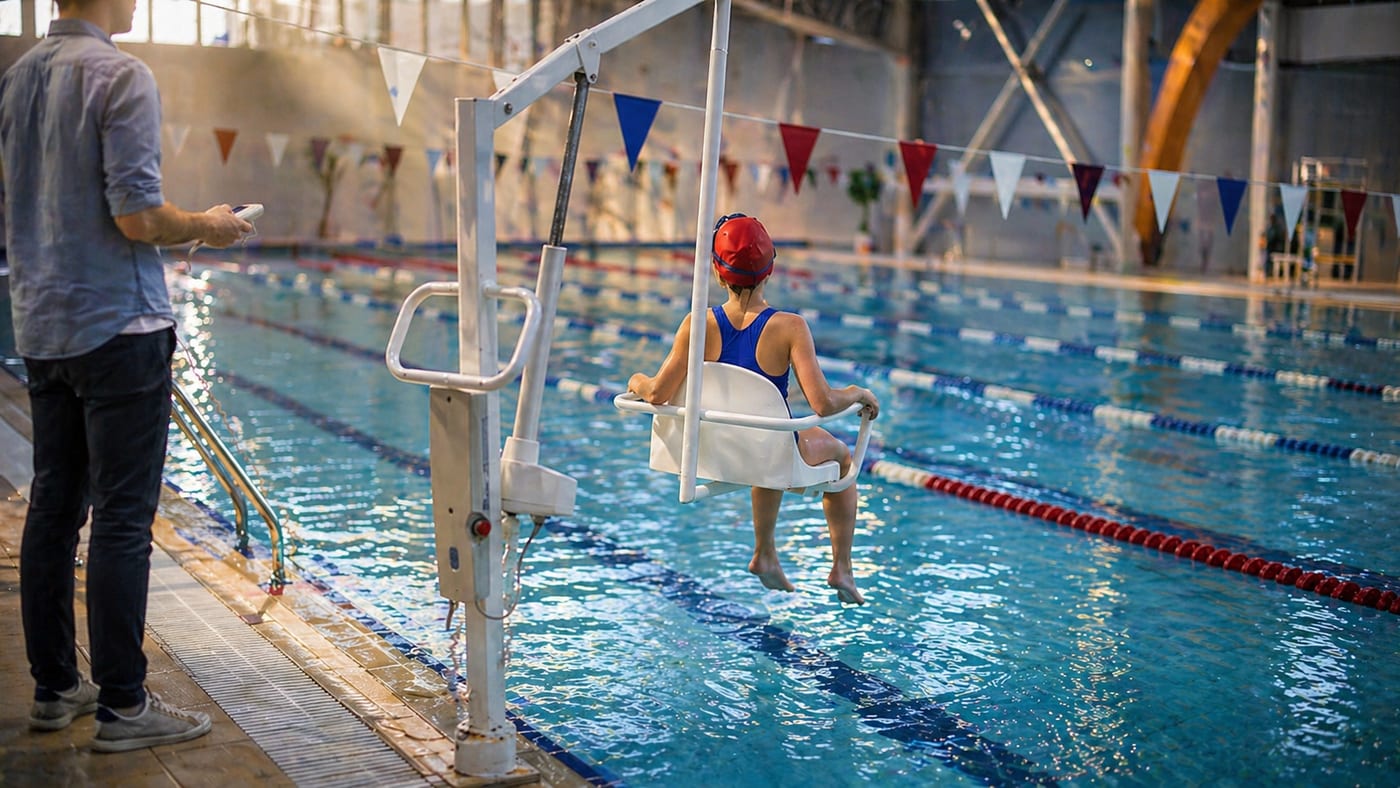
Adaptive recreation includes wheelchair sports, sensory-friendly swim times for people with autism or sensory processing disorders, modified group fitness classes for participants with mobility limitations, adaptive personal training with certified instructors trained in disability-specific physiology, and therapeutic aquatics in pools with chair lifts or zero-depth entry.
These are not niche services. They are standard offerings at public recreation centers in cities across the country. Private gyms generally do not offer them for a straightforward reason: adaptive programming requires specialized equipment, trained staff, and facility design features (accessible pool entry, wider doorways, sensory-controlled environments) that are not part of the commercial fitness model.
The distinction is structural, not a criticism. Private gyms are designed for profit-driven individual fitness. Public recreation centers are designed for community-wide access, and under the Americans with Disabilities Act, they are required to provide reasonable accommodation so that people with disabilities can participate in recreation programs. That legal obligation, combined with the programming flexibility of a public facility, is what makes recreation centers the primary vehicle for adaptive recreation in most American cities.
What other cities already provide
Several cities have built adaptive recreation programs that demonstrate what is possible when a public facility is designed with inclusion as a core principle, not an afterthought.
Salt Lake County's Adaptive Recreation program offers inclusive fitness passes for people with disabilities and an assistant, adaptive swim lessons and water polo, wheelchair sports, adaptive personal training with certified trainers who provide customized workouts, cooking classes, continuing education, and Saturday night dances. The program serves individuals with physical, developmental, and intellectual disabilities across the county's recreation centers.
Portland Parks and Recreation runs an Adaptive Recreation Program that includes wheelchair basketball, a wheelchair treadmill designed for cardio workouts in a seated position, sensory gym sessions for children ages 2 to 5 with sensory sensitivities, and adaptive swim with a more sensory-controlled pool environment. All Portland pools have chair lifts with straps or zero-depth entry and pool-accessible wheelchairs.
Philadelphia's "Rec for All" initiative is a system-wide inclusion plan that makes recreation centers welcoming for people with disabilities and neurodiverse residents. Programming includes day programs, music therapy, arts and crafts, and accessible pool facilities with lifts.
These are not extraordinary programs in extraordinary cities. They are what public recreation infrastructure is designed to make possible. They exist because a public facility was built, staffed, and programmed with the understanding that "the community" includes people with disabilities.
What Twin Falls currently has
Twin Falls has no public recreation center. That means it has no adaptive recreation programming delivered through a public facility. No wheelchair-accessible pool with chair lifts or zero-depth entry. No sensory-friendly gym times. No adaptive fitness with certified trainers. No centralized inclusive recreation hub.
Private gyms in town serve their purpose, but they are not designed, equipped, or obligated to fill this gap. School facilities are not publicly accessible for community adaptive programming. The city pool, currently undergoing $2 million-plus renovation, serves aquatics seasonally but does not offer year-round adaptive programming.
For the estimated 7,700 or more Twin Falls residents living with a disability, the recreation options available locally are, functionally, the same options available to everyone else, minus the accommodations that would make those options accessible.
A 2024 qualitative study published in BMC Public Health examined what makes recreation centres work for people with disabilities. The key facilitators identified by participants were accessible facility design, specially trained staff, tailored exercise programs, opportunities to socialize, specialized equipment, and an inclusive environment. The key barriers were inaccessible facilities, untrained staff, and lack of adaptive programming. Twin Falls currently has every barrier on the list and none of the facilitators.
Why this matters for the rec center conversation
The NRPA defines inclusion as "removing barriers, both physical and theoretical, so that all people, including those with physical and cognitive disabilities, have an equal opportunity to enjoy the benefits of parks and recreation." The organization's Parks and Recreation Inclusion Report found that only two in five park and recreation agencies currently have a formal inclusion policy, identifying a gap that the field itself recognizes.
For Twin Falls, the disability access question is not an add-on to the recreation center conversation. It is a fundamental part of it. A well-designed facility built with ADA compliance from the ground up, staffed with trained instructors, and programmed with adaptive offerings alongside general programming does not just serve people with disabilities. It serves the entire community better, because inclusive design improves the experience for seniors with mobility limitations, parents with strollers, people recovering from surgery, and anyone whose needs do not fit the standard gym model.
The CDC puts it plainly: "People with disabilities are a large part of every community and population. Many of us know, or are, someone with a disability, and disability inclusion is beneficial for all."
Where the conversation stands
A recreation center committee within the Twin Falls Parks and Recreation Department has been studying this question since 2017. In June 2025, the City Council voted to advance the long-stalled feasibility study. Parks and Recreation Director Wendy Davis said the council's vote "breathed a little bit of life into what I thought was a dying initiative."
A grassroots advocacy campaign has proposed naming a potential facility after U.S. Army Specialist Troy Carlin Linden, a soldier with the 54th Engineer Battalion who was killed in action on July 8, 2006, in Ar Ramadi, Iraq. The proposal comes from a Twin Falls resident who served in the same unit.
As the feasibility process moves forward, the question of who a recreation center is designed to serve will shape every decision about the building, from pool entry design to programming staff to facility layout. Disability access is not a feature to be added later. It is a design principle that determines whether the facility serves the full community or only part of it.
Closing
Roughly 7,700 Twin Falls residents live with a disability. Nearly half of adults with disabilities nationwide get no aerobic physical activity. The health consequences of that inactivity are three times the chronic disease risk of the general population.
Other Idaho and western U.S. cities have addressed this through public recreation centers with adaptive programming, accessible design, and trained staff. Twin Falls has no comparable infrastructure. For a city studying whether to build a recreation center, the disability access question is not a secondary consideration. It is a measure of whether the facility, if built, will serve the community it claims to represent.
Frequently Asked Questions
How many Twin Falls residents have a disability? The CDC reports that more than 1 in 4 U.S. adults live with a functional disability. Applied to Twin Falls' population of roughly 57,325, a conservative estimate using Census data (13.5% prevalence) suggests approximately 7,700 residents. The actual number may be higher, particularly given the city's senior population, where disability prevalence exceeds 43%.
What is adaptive recreation? Adaptive recreation refers to modified sports, fitness, and leisure programming designed to include people with physical, developmental, or intellectual disabilities. Examples include wheelchair basketball, sensory-friendly swim times, adaptive personal training, modified group fitness classes, and therapeutic aquatics in pools with accessible entry. These programs are standard at public recreation centers in many U.S. cities.
Do private gyms offer adaptive programming? Generally, no. Private fitness facilities are designed around individual exercise for able-bodied members. They are not typically equipped with accessible pool entry, sensory-controlled environments, or staff trained in disability-specific fitness. Public recreation centers are both better equipped and legally required under the ADA to provide reasonable accommodation for people with disabilities.
What cities have strong adaptive recreation programs? Salt Lake County offers adaptive fitness, wheelchair sports, adaptive swim, and personal training for people with disabilities. Portland provides wheelchair basketball, wheelchair treadmills, sensory gyms, and adaptive swim. Philadelphia's "Rec for All" initiative is a system-wide inclusion plan across its recreation centers. These programs operate through public facilities with trained staff and accessible design.
Would a Twin Falls recreation center be required to be ADA accessible? Yes. Under the Americans with Disabilities Act, public recreation facilities must meet accessibility standards and provide reasonable accommodation for people with disabilities to participate in programs. This includes accessible facility design (entrances, restrooms, pool entry) and programming that accommodates participants with varying abilities.
Is Twin Falls actively considering a recreation center? A city committee has been studying the question since 2017. In June 2025, the City Council voted to advance the feasibility process. No specific site, cost, or funding mechanism has been finalized as of this writing.
Where can residents follow the conversation? Twin Falls City Council meetings are open to the public, and the Parks and Recreation Department posts updates on the city's official website. A community advocacy group is also tracking the issue at twinfallsreccenter.com.