Rec Center
How the Nampa Rec Center Has Paid for Itself for 30 Years
TL;DR:
The Nampa Recreation Center opened in April 1994, funded without a property tax increase through a combination of Certificates of Participation, donated land, a cable franchise fee, business donations, and more than 13,000 charter memberships pre-sold before the doors opened. The facility paid off its debt nine years early, carries roughly $3 million in reserves, and has covered 100 percent of its operating costs from user fees for more than three decades. No taxpayer subsidy. The most common objection to a Twin Falls recreation center is cost. Nampa answered that objection 30 years ago, 130 miles away, in the same state, with the same politics and the same taxpayer skepticism.
When residents in Twin Falls hear the words "recreation center," many of them think of two things: how much it would cost to build, and how much it would cost to keep running. Both are reasonable concerns. But they are not unanswered questions. They have been answered, in detail, by a city 130 miles west on Interstate 84.
The Nampa Recreation Center, now called the Harward Recreation Center, has been operating continuously since April 1994. It has never required a taxpayer subsidy for operations. It paid off its construction debt nine years ahead of schedule. It funds its own capital improvements from its own reserves. And it has done all of this in Idaho, under the same fiscal constraints and political climate that Twin Falls operates in today.
This is not a hypothetical model. It is a 30-year track record sitting on public record.
The problem Nampa was solving
In the early 1990s, Nampa faced a set of problems that will sound familiar to anyone following the Twin Falls conversation.
According to the city's own published history, the existing Senior Center was crowded and had accessibility problems. Teenagers lacked a community gathering place. Recreational opportunities for children were limited to the summer months. And people of all ages needed a healthy, family-centered place to exercise year-round.
City leaders wanted a facility that would inspire civic pride and become a focal point for the community. The challenge was how to pay for it in a city that was, at the time, significantly smaller than Twin Falls is today.
How it was funded without raising taxes
The financing model Nampa developed is the part of the story that most Twin Falls residents have never heard, and it is the part that matters most.
The city did not pass a bond. It did not raise property taxes. Instead, it assembled a layered funding structure from multiple sources:
Certificates of Participation: Investors purchased $6.5 million in COPs, a financing mechanism that does not require voter approval and does not constitute general obligation debt. The certificates were backed by confidence in the project's revenue projections.
Donated land: Mercy Medical Center donated a 13-acre site for the building, eliminating one of the largest capital costs in any facility project.
Cable franchise fee: A 2 percent television cable franchise fee was pledged to the recreation center until 2003, providing a dedicated revenue stream during the early operating years.
Business donations: Several local businesses made large donations during the planning and construction phase.
Charter memberships: By the time the building was finished, more than 13,000 people had purchased memberships. That pre-construction demand did two things: it demonstrated community support to investors and lenders, and it generated revenue before the facility opened.
City inner-fund loan: The city budgeted an internal loan to bridge remaining costs.
The Idaho Press reported in 2015 that the COP debt was paid off in November 2003, nine years ahead of the original schedule. From that point forward, the facility has operated entirely on user-generated revenue.
For Twin Falls residents concerned about the financial viability of a recreation center, Nampa's financing story is the most relevant precedent available: an Idaho city, using Idaho-legal financing tools, with Idaho voters, building a facility that paid for itself.
What generates the revenue
A recreation center does not sustain itself on memberships alone. Nampa's financial model works because it layers multiple revenue streams on top of each other, and because the facility is programmed broadly enough to serve the full community rather than a single demographic.
The Harward Recreation Center is 140,000 square feet. It is open Monday through Friday from 5:00 a.m. to 10:00 p.m., Saturday from 8:00 a.m. to 7:00 p.m., and Sunday from 11:00 a.m. to 6:00 p.m. Here is what fills those hours and generates the revenue:
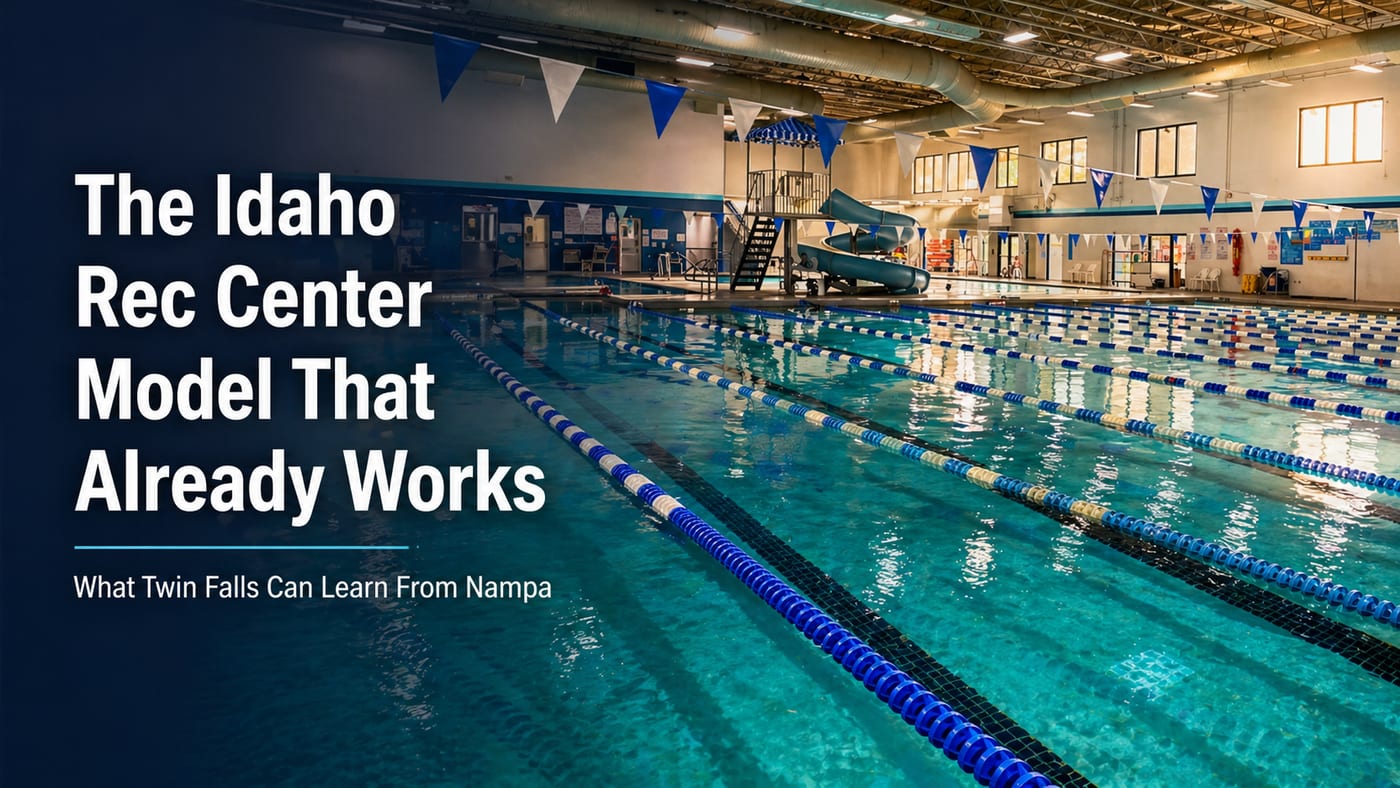
Aquatics: Five indoor pools, including a 10-lane, 25-yard lap and competition pool, a diving pool, a hydrotherapy pool, a kids' pool kept at 90°F, and a recreation pool at 88°F with a 53-foot waterslide and spray fountain. A sauna, steam room, and spa round out the aquatics complex. The facility hosts a competitive swim team, year-round swim lessons from infant acclimation through stroke development, 30-plus water fitness classes per week, and open kayaking from January through April.
Courts and fitness: Two and a half basketball courts, five racquetball courts, pickleball and wallyball courts, indoor rock climbing walls, a large weight room with free and machine weights, a youth weight room for ages 10 to 14, cardio equipment, and a group fitness studio running classes including cycling, step, and dance formats.
Tracks: A 1/5-mile indoor track and a 1/2-mile outdoor track, both available to members daily.
Youth and family: Supervised childcare for children 5 and under, a Youth Activity Center for ages 6 to 12, preschool classes, youth sports camps, and family swim nights where parents drop off kids for supervised pool time.
Senior programming: A dedicated Senior Center wing opened in September 1994, five months after the main facility. The center provides fitness, social programming, and wellness activities. The facility accepts SilverSneakers and Silver & Fit memberships, making it accessible to seniors on Medicare Advantage plans at no additional out-of-pocket cost.
Community programming: CDC Diabetes Prevention Program classes, health screenings, cooking classes, STEM programs for kids, dance camps, and community events throughout the year.
Each of these categories generates its own revenue through memberships, program fees, day passes, punch passes, and facility rentals. The breadth is the point. A facility that serves only fitness enthusiasts has a narrow revenue base. A facility that serves swimmers, seniors, families, youth athletes, and casual exercisers has a broad one. Nampa built for breadth, and it has sustained operations for three decades because of it.
The financial track record
The numbers are documented by the city's own staff, on the record.
Nampa Parks and Recreation Director Darrin Johnson, speaking to the Idaho Press, put it plainly: "Recreation Center fees cover 100 percent of the costs. That's a big accomplishment for the Recreation Center. It doesn't have a burden on taxpayers. All of our operations are paid by user fees."
The facility generates approximately $3 million per year in revenue. It carries roughly $3 million in reserve funds. When major maintenance items come due, they are paid from reserves, not from the city's general fund. In 2015, nearly $1 million in roof, HVAC, and lighting renovations were funded entirely from the facility's own fund balance.
Johnson contrasted this with two other Nampa public facilities, the Ford Idaho Center and the Nampa Civic Center, both of which require annual subsidies from city coffers. The recreation center does not.
The facility's own FAQ states it directly: "The Nampa Recreation Center is a self funded facility. That means that we must recover enough revenue to cover our expenses in payroll, utilities, new equipment, etc. We are not a tax subsidized facility which means that in order to keep up with rising costs, we must increase our rates. They typically raise at the current rate of inflation."
There are years when expenses exceed revenue, typically when large capital improvements are made. But those are funded from reserves built during surplus years, not from taxpayer dollars. The model is designed for long-term self-sufficiency, not year-to-year profit.
The philosophy behind the pricing
One detail from Nampa's founding is worth noting because it shapes the entire revenue model.
The original pricing structure was designed so that the Couple Membership would include children for free, regardless of whether a family had two children or six. This became known as the Family Membership. The facility was, in the words of its own FAQ, "founded on the idea that it would remain an affordable place for all families."
That philosophy is not just a values statement. It is a revenue strategy. By keeping family pricing flat regardless of household size, Nampa made the rec center accessible to the exact demographic that drives the highest engagement: families with multiple children. Those families show up consistently, they enroll in programs, and they renew. The pricing model generates loyalty, and loyalty generates sustainable revenue.
Current youth memberships run approximately $33 per month. For a Twin Falls family currently spending $3,700 to $4,900 per year on fragmented private recreation, the Nampa pricing model represents a fraction of that cost for broader access.
What tournament and event hosting adds
Memberships, program fees, and day passes are the foundation of the revenue model. Facility rentals and event hosting add a layer on top.
Nampa's basketball courts, pools, and multipurpose spaces are available for rental by leagues, clubs, and tournament organizers. When the facility hosts a swim meet or a weekend basketball event, it generates rental fees directly and draws visiting families who purchase day passes, food, and programming. The economic effects of tournament hosting on local businesses extend beyond the facility itself, flowing into hotels, restaurants, and retailers.
The tournament function is not the primary revenue driver. Memberships are. But it is the revenue layer that brings outside money into the community, which memberships alone cannot do. A well-designed facility generates both internal revenue (from residents who use it daily) and external revenue (from visitors who come for events). Nampa's 30-year model demonstrates both.
What Twin Falls can learn
Nampa and Twin Falls are not identical cities. Nampa sits in the Boise metro area with access to a larger regional population. Twin Falls, at 57,325 residents, is the hub of a more geographically isolated region with a metro area of roughly 122,000. The two cities have different growth trajectories and different competitive landscapes.
But the similarities are more instructive than the differences. Both are Idaho cities operating under the same state tax structure, the same 66.67 percent bond supermajority requirement, and the same taxpayer skepticism about public spending. Nampa was smaller than Twin Falls is today when it built its recreation center. If the model works in Nampa under those constraints, the structural question is not whether it can work in Twin Falls. It is whether Twin Falls is willing to execute it.
The transferable lessons are specific:
The layered funding model (COPs, donated land, franchise fee, charter memberships, business donations) avoids the bond election that Idaho's supermajority threshold makes nearly impossible. The charter membership strategy demonstrates community demand to investors before construction begins. The breadth of programming generates a revenue base wide enough to sustain operations without subsidy. And the reserve-building discipline ensures that capital improvements are self-funded rather than deferred.
None of these lessons require guesswork. They are documented in Nampa's published history, confirmed on the record by the city's Parks and Recreation Director, and validated by 30 years of continuous operation.
Where the Twin Falls conversation stands
A recreation center committee within the Twin Falls Parks and Recreation Department has been studying this question since 2017. In June 2025, the City Council voted to advance the long-stalled feasibility study. Parks and Recreation Director Wendy Davis said the council's vote "breathed a little bit of life into what I thought was a dying initiative."
A grassroots advocacy campaign has proposed naming a potential facility after U.S. Army Specialist Troy Carlin Linden, a soldier with the 54th Engineer Battalion who was killed in action on July 8, 2006, in Ar Ramadi, Iraq. The proposal comes from a Twin Falls resident who served in the same unit.
Closing
The most common objection to a Twin Falls recreation center is that it will cost too much and never pay for itself. That objection is understandable. It is also answerable, because an Idaho city 130 miles away answered it three decades ago and has been proving the answer right every year since.
The Nampa Recreation Center was not built by a wealthy city with money to spare. It was built by a community that identified a problem, assembled a creative financing model, pre-sold 13,000 memberships to prove demand, and then operated the result with enough discipline to never need a dollar of taxpayer subsidy. The facility is still open. The reserves are still growing. The model still works.
Whether Twin Falls follows that path is a decision for the council and the residents who weigh in. What Nampa's 30-year record makes clear is that the question is no longer whether a self-sustaining recreation center is possible in Idaho. That question was settled in 1994.
Frequently Asked Questions
How is the Nampa Recreation Center funded? The facility was originally funded through $6.5 million in Certificates of Participation, a 13-acre land donation from Mercy Medical Center, a 2 percent cable franchise fee, business donations, and more than 13,000 charter memberships pre-sold before opening. No property taxes were raised. The COP debt was paid off in 2003, nine years ahead of schedule.
Does the Nampa Recreation Center receive taxpayer money? No. The facility covers 100 percent of its operating costs from user fees, including memberships, program fees, day passes, and facility rentals. The Parks and Recreation Director confirmed this on the record with the Idaho Press. The facility carries roughly $3 million in reserves and funds its own capital improvements.
What does the Nampa Recreation Center include? The 140,000-square-foot facility includes five indoor pools, 2.5 basketball courts, five racquetball courts, pickleball courts, indoor rock climbing, a large weight room, a youth weight room, indoor and outdoor tracks, a group fitness studio with 30-plus weekly classes, supervised childcare, a Youth Activity Center, a dedicated Senior Center wing, and year-round programming including swim lessons, sports camps, and community events.
How much does a membership cost? The Nampa Recreation Center does not publish exact prices online (prospective members visit the front desk), but youth memberships are approximately $33 per month based on current published swim team requirements. Family memberships include all dependent children for free under one flat rate, a pricing philosophy established at the facility's founding.
Could this model work in Twin Falls? The structural elements are transferable: layered financing that avoids a bond election, charter memberships that prove demand before construction, programming breadth that generates a wide revenue base, and reserve-building discipline for capital maintenance. Twin Falls operates under the same state tax structure and bond requirements as Nampa. The Nampa model was built for exactly those constraints.
Is Twin Falls actively considering a recreation center? A city committee has been studying the question since 2017. In June 2025, the City Council voted to advance the feasibility process. No specific site, cost, or funding mechanism has been finalized as of this writing.
Where can residents follow the conversation? Twin Falls City Council meetings are open to the public, and the Parks and Recreation Department posts updates on the city's official website. A community advocacy group is also tracking the issue at twinfallsreccenter.com.