Rec Center
Indoor Soccer Has No Home in Twin Falls. Futsal Can Fix That.
TL;DR:
Soccer is the third most popular youth sport in America, and the 2026 FIFA World Cup on U.S. soil is about to push interest even higher. Twin Falls has active youth soccer programs, but when outdoor fields shut down from November through March, local players have nowhere to train or compete indoors. Futsal, FIFA's official indoor version of soccer, is played on basketball-sized courts. The proposed Twin Falls recreation center's four regulation basketball courts could host futsal leagues, training programs, and regional tournaments without any additional construction. Right now, Twin Falls soccer families either stop playing for five months or drive to other cities. A rec center with futsal programming would keep them playing at home.
The tournament hosting conversation for Twin Falls has covered basketball, volleyball, pickleball, and wrestling. Each of those sports has a documented case for what tournament hosting brings to a community. But there is a sport that reaches a broader cross-section of Twin Falls' population than any of them, and it currently has no indoor home in the city at all.
Soccer is the world's most played sport. In Twin Falls, it is also the sport most affected by the city's five-month winter. When outdoor fields freeze over in November, the soccer community does not have a place to go. Futsal, the indoor version of the game built for exactly the kind of courts a recreation center provides, is the answer that other communities figured out years ago.
What futsal actually is
Futsal is not indoor soccer played against boards and walls. It is FIFA's official indoor version of the game, played five-a-side on a hard court surface the size of a basketball court. There are no walls, no boards, and no bouncing the ball off barriers. The court is defined by lines, the ball is smaller with less bounce than a regulation soccer ball, and substitutions are unlimited. The game is fast, technical, and built around close control and quick decision-making.
U.S. Futsal, which introduced the sport to America in 1981 and has governed it for more than four decades as a member of U.S. Soccer, describes it simply: futsal is the version of soccer played on basketball-sized courts all over the world. FIFA has held nine Futsal World Championships to date.
The development connection is well established. World-class players including Lionel Messi, Cristiano Ronaldo, Neymar, and Diego Maradona have all credited futsal with developing their ball control and decision-making skills. A futsal player touches the ball up to ten times more per match than in a standard outdoor soccer game. That repetition is why soccer federations around the world now use futsal as a core part of youth player development.
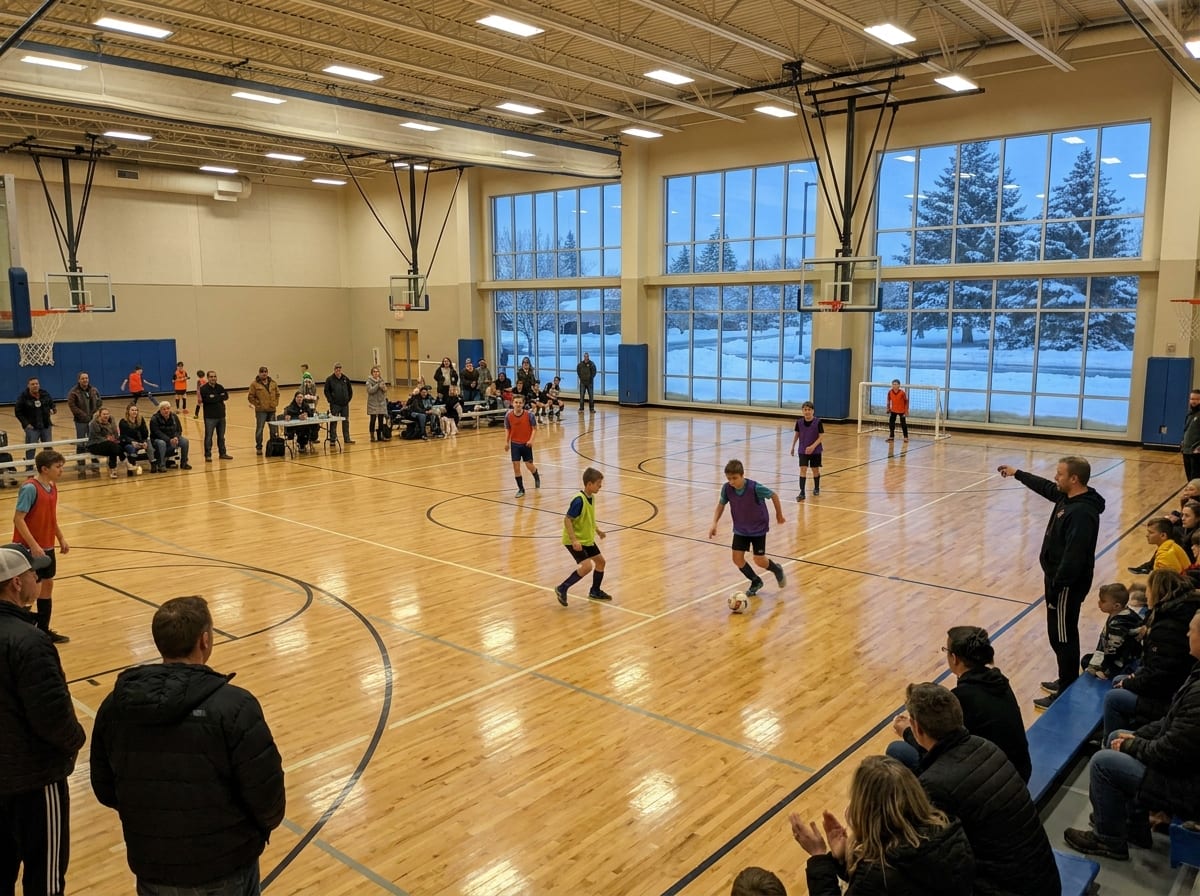
For Twin Falls, the most important fact about futsal is the simplest one: it is played on a basketball court. The proposed recreation center's four regulation basketball courts are, by definition, four futsal courts. No specialized surface. No additional construction. No boards to install or remove. The infrastructure for futsal tournaments already exists in the facility plan.
Why Twin Falls' soccer community needs an indoor home
Soccer is the third most popular youth sport in America, behind basketball and baseball. High school boys soccer had 484,908 participants nationally in 2024-25, and girls soccer had 383,895, according to the NFHS. Twin Falls High School and Canyon Ridge High School both field competitive soccer programs. Youth club soccer operates across the Magic Valley through local leagues and regional clubs.
The problem is not participation. The problem is the calendar.
Twin Falls' outdoor soccer season runs roughly from April through October. From November through March, fields are frozen, covered in snow, or too cold and wet to use safely. That is five months without competitive play, organized training, or structured league activity for every soccer player in the city.
In communities with indoor recreation facilities, this gap does not exist. Futsal leagues run through the winter. Youth players continue developing skills on hard courts instead of losing five months of touch and fitness. Coaches maintain programming continuity. Teams stay together rather than scattering until spring.
In Twin Falls, none of that happens because there is no indoor facility to host it. Soccer families either stop playing for nearly half the year or drive to other cities for indoor options. Neither outcome serves the community well.
What futsal tournaments look like at a recreation center
A futsal tournament at a community recreation center is not a 300-team national event. It is a regional competition that draws 16 to 40 teams from across southern Idaho for a weekend of organized play. That is exactly the scale that a four-court facility is designed to handle.
A typical community futsal tournament runs Saturday and Sunday on four courts operating simultaneously. Each court hosts back-to-back matches in 25-minute halves with short breaks between games. A 24-team youth tournament can complete pool play and bracket rounds across a single weekend. Teams from Jerome, Burley, Pocatello, Idaho Falls, Boise, and surrounding communities travel to Twin Falls, bringing families with them.
Those families need the same things every visiting tournament group needs: hotel rooms for Friday and Saturday nights, meals at local restaurants, gas, and something to do between matches. The spending is more modest than a 300-team volleyball showcase, but it is real, it is recurring, and it flows into Twin Falls businesses during the winter months when they need it most.
A rec center that hosts four or five futsal tournaments per winter, alongside its basketball, volleyball, and wrestling events, is not relying on any single sport to fill its calendar. It is layering multiple sports across different weekends, each one bringing a different community of athletes and families through the doors. That diversification is what makes a facility financially sustainable over decades.
The sport that serves Twin Falls' most diverse community
Soccer is the most globally played sport on earth, and in Twin Falls, that global reach has a local dimension that no other tournament sport matches.
Twin Falls has a growing and culturally diverse population that includes families from Latin America, East Africa, and Southeast Asia. For many of these families, soccer is not just a sport. It is the first point of community connection in a new country. It is the game their children already know how to play, the game that requires no expensive equipment to start, and the game that creates common ground across language and cultural barriers.
A recreation center that offers futsal leagues and tournaments is not just serving athletes. It is providing a gathering space where Twin Falls' newest residents can participate in community life through the sport that is most familiar and most accessible to them. That social infrastructure function, which the Surgeon General's 2023 advisory identified as critical for combating isolation, is something a basketball or wrestling tournament cannot replicate for this population in the same way.
This is not an abstract diversity argument. It is a practical one. A rec center futsal league on a Wednesday evening in January brings together families who might never otherwise cross paths. That is what community recreation infrastructure is designed to do.
The 2026 World Cup and what comes after
The timing of the Twin Falls recreation center conversation coincides with the biggest moment in American soccer history.
The 2026 FIFA World Cup will be co-hosted by the United States, Canada, and Mexico. It will be the first World Cup on U.S. soil since 1994, when the tournament set attendance records and directly led to the creation of Major League Soccer. U.S. Soccer's Pathway Strategy explicitly aims to use the World Cup as a catalyst to make soccer the highest-participation sport in the country, reduce costs for young players, and expand local playing opportunities.
When the World Cup arrives in the summer of 2026, soccer interest across America will surge. Youth registration will spike. Families who have never considered organized soccer will sign their children up. And communities that have indoor facilities for year-round play will be positioned to capture and sustain that interest. Communities that do not will watch the wave arrive and recede because they have nowhere to channel it once outdoor season ends.
A Twin Falls recreation center with futsal programming would be ready for that wave. Without one, the city's soccer community will do what it has always done: play outdoors for seven months, then stop.
The facility efficiency argument
Every tournament sport blog in this series has described what a recreation center needs to host that particular sport. Basketball needs multi-court gymnasium space. Volleyball uses the same courts in a different configuration. Wrestling lays mats on the gymnasium floor. Pickleball needs dedicated courts.
Futsal adds another sport to the facility's calendar without adding any infrastructure. The same four basketball courts that host a basketball tournament one weekend and a wrestling invitational the next host a futsal tournament on a different weekend. The court markings are the only addition, and many recreation centers paint permanent futsal lines alongside basketball lines at minimal cost.
This is the cumulative argument that the tournament series has been building toward: a single multi-court facility does not serve one sport. It serves five, six, or more, each with its own audience, its own season, and its own revenue contribution. Futsal fills the winter soccer gap. Basketball fills the winter and spring court-sports gap. Volleyball fills the late winter and spring gap. Wrestling fills the deep winter gap. Pickleball runs year-round on dedicated courts.
Together, they create a facility that operates at high utilization twelve months a year. That is how Nampa has sustained its recreation center for three decades without taxpayer subsidy: not by serving one sport, but by serving all of them.
Where the conversation stands
A recreation center committee within the Twin Falls Parks and Recreation Department has been studying this question since 2017. In June 2025, the City Council voted to advance the long-stalled feasibility study. Parks and Recreation Director Wendy Davis said the council's vote "breathed a little bit of life into what I thought was a dying initiative."
A grassroots advocacy campaign has proposed naming a potential facility after U.S. Army Specialist Troy Carlin Linden, a soldier with the 54th Engineer Battalion who was killed in action on July 8, 2006, in Ar Ramadi, Iraq. The proposal comes from a Twin Falls resident who served in the same unit.
Closing
Soccer is the world's most popular sport and America's third most popular youth sport. The 2026 FIFA World Cup is about to amplify that popularity in ways the country has not seen since 1994. Twin Falls has active soccer programs, competitive high school teams, and a diverse community for whom soccer is the most natural point of connection.
What Twin Falls does not have is anywhere for that community to play indoors from November through March, or anywhere to host the regional futsal tournaments that would keep players competing and bring visiting teams into the Magic Valley during the winter months. The proposed recreation center's four basketball courts are, by design, four futsal courts. The infrastructure is already in the plan. The sport is already in the community. The five-month gap between the two is what the facility would close.
Frequently Asked Questions
What is futsal? Futsal is FIFA's official indoor version of soccer, played five-a-side on a basketball-sized hard court with a smaller, low-bounce ball. There are no walls or boards. It was introduced to the United States in 1981 and has been governed by U.S. Futsal as a member of U.S. Soccer for more than four decades. World-class players including Messi, Ronaldo, and Neymar have credited futsal with developing their technical skills.
Can futsal be played on basketball courts? Yes. Futsal is specifically designed for basketball-sized courts. The proposed Twin Falls recreation center's four regulation basketball courts would function as four futsal courts with no additional construction or specialized surfaces. Many recreation centers paint permanent futsal lines alongside basketball lines.
What does a futsal tournament at a rec center look like? A typical community futsal tournament draws 16 to 40 teams from across the region for a weekend of play on four courts running simultaneously. Teams from surrounding cities bring families who need hotel rooms, meals, and local spending. The scale is smaller than a national event but recurring and consistent through the winter months.
Why does indoor soccer matter for Twin Falls specifically? Twin Falls' outdoor soccer season runs roughly April through October. From November through March, fields are frozen or unusable. Without an indoor facility, soccer players lose five months of training, competition, and skill development every year. Futsal fills that gap completely.
How does the 2026 World Cup affect this? The FIFA World Cup on U.S. soil is expected to drive a surge in soccer interest and youth registration nationwide. Communities with indoor facilities will be positioned to sustain that interest year-round. Communities without indoor options will see the wave arrive in summer and fade when outdoor season ends.
Is Twin Falls actively considering a recreation center? A city committee has been studying the question since 2017. In June 2025, the City Council voted to advance the feasibility process. No specific site, cost, or funding mechanism has been finalized as of this writing.
Where can residents follow the conversation? Twin Falls City Council meetings are open to the public, and the Parks and Recreation Department posts updates on the city's official website. A community advocacy group is also tracking the issue at twinfallsreccenter.com.