Rec Center
Wrestling Runs Deep in Idaho. Twin Falls Can't Host a Meet.
TL;DR:
Boys high school wrestling topped 300,000 participants for the first time in 2024-25. Girls wrestling topped 74,000, growing 102 percent in three years. Idaho sanctions wrestling in four classifications and holds its state tournament at the 12,000-seat Ford Idaho Center in Nampa. Wrestling tournaments in mid-sized cities routinely generate $1 million to $3.7 million in economic impact, and they do it during the winter months when hotels and restaurants need it most. Twin Falls has two high school wrestling programs and no public facility capable of hosting a tournament. Every invitational that could happen here happens somewhere else.
The tournament sports conversation for Twin Falls has so far focused on basketball, volleyball, and pickleball. Each has a documented economic case. But there is a sport with deeper roots in Idaho than any of them, one that fills gymnasiums in November when nothing else can, and one whose growth story over the past three years has been among the most dramatic in American high school athletics.
Wrestling is not a sport that needs to be introduced to the Magic Valley. It needs a venue.
A sport Idaho already knows
Wrestling is part of Idaho's athletic identity in a way that few other sports can claim. The IHSAA sanctions wrestling in four classifications, and the state tournament, held annually at the 12,000-seat Ford Idaho Center Arena in Nampa, is one of the most attended high school sporting events in the state.
The sport's culture in Idaho runs deep. Nampa's wrestling program has earned six consecutive state trophies and produced an individual state champion seven years in a row. Programs across the state, from Minico to Shelley to Bishop Kelly, draw passionate communities of athletes, coaches, and families who treat the wrestling season as the center of their winter calendar.
Twin Falls is part of this tradition. Both Twin Falls High School and Canyon Ridge High School compete in IHSAA wrestling. Their athletes train through the November-to-February season, compete in district and regional tournaments, and travel to Nampa for the state championships. The sport is here. The coaching is here. The families are here.
What is not here is a facility where Twin Falls can host a wrestling tournament of its own.
The national growth nobody expected
Wrestling's participation numbers over the past three years have surprised even the sport's own advocates.
According to the National Federation of State High School Associations, boys high school wrestling topped 300,000 participants for the first time in the 2024-25 school year, reaching 300,214. That makes wrestling the sixth most popular boys high school sport in the country, behind only football, outdoor track and field, basketball, soccer, and baseball. Since 2021-22, boys wrestling has gained roughly 60,000 participants, a 25 percent increase in three years.
The girls side of the story is even more striking. Girls wrestling topped 74,000 participants for the first time in 2024-25, a 15 percent increase from the prior year. Nearly 1,000 new schools added girls wrestling programs in a single year. Since 2021-22, girls wrestling participation has grown 102 percent, more than doubling in three seasons.
Idaho has been part of this wave. Girls wrestling received its first IHSAA-sanctioned state tournament in 2022, with eight weight classes that quickly expanded to ten due to demand. The sport is no longer emerging in Idaho. It is established, competitive, and growing.
Both the boys and girls records set in 2024-25 are all-time highs. Wrestling is not a sport in decline looking for a lifeline. It is a sport at its peak participation looking for places to compete.
What wrestling tournaments generate for host cities
Wrestling tournaments follow the same economic pattern as basketball, volleyball, and pickleball events: visiting athletes and families book hotel rooms, eat at restaurants, buy gas, and spend money in the host city. But wrestling has a few characteristics that make its economic profile distinctive.
The documented impact at the mid-sized level is significant. The 2024 IHSAA State Wrestling Tournament in Evansville, Indiana generated $3.74 million in economic impact and filled 2,482 hotel room nights. The Spartan Combat Nationals in Kissimmee, Florida, a youth and high school tournament, generated $2.33 million in economic impact and 4,458 hotel room nights. In Springfield, Missouri, the Missouri USA Wrestling Championships generated 1,500 hotel room nights and over $1 million in economic impact, and the city secured the event for three consecutive years.
The Super 32 wrestling tournament in Greensboro, North Carolina has been recognized by Sports Destination Management as a major tourism driver that "cements the city as a premier wrestling destination." In Kalamazoo, Michigan, wrestling was one of the top four sports accounting for 53 percent of all sports tourism hotel room nights in 2024.
These are not Olympic-level events in major cities. They are regional and national youth tournaments in mid-sized communities that built the facilities to host them.
Why wrestling economics hit different in winter
Every tournament sport generates economic activity. What sets wrestling apart is when it generates that activity.
Wrestling season runs from November through February. In Twin Falls, those are the coldest months of the year, when average highs drop into the mid-30s, outdoor recreation infrastructure goes offline, and the local hospitality industry enters its slowest period.
A wrestling tournament that fills 1,500 to 2,500 hotel rooms on a January weekend is not competing with summer tourism for capacity. It is filling rooms that would otherwise sit empty. It is bringing restaurant traffic during the months when restaurants need it most. It is generating sales tax revenue during the quarter when retail activity is at its lowest.
This seasonal alignment is precisely what makes wrestling tournaments valuable to a city like Twin Falls. The economic case for a recreation center has been made broadly. Wrestling tournaments sharpen that case by putting the economic activity in the exact months when the city's economy is most in need of it.
The spectator intensity factor
Wrestling tournaments also generate a higher ratio of spectators to competitors than most other indoor sports. A basketball game has ten players on the court. A volleyball match has twelve. A wrestling match has two.
But those two athletes on the mat are surrounded by teammates, coaches, and family members who traveled together, who sit in the stands for the full day, and who spend accordingly. A 200-wrestler tournament might draw 800 to 1,200 total visitors when families and coaching staffs are included. A 500-wrestler regional event can draw 2,000 to 3,000.
The emotional intensity of wrestling adds another dimension. Wrestling families are famously committed. They travel farther, attend more consistently, and treat tournament weekends as family events in a way that translates directly to local spending. Hotel stays extend from Friday through Sunday. Meals are eaten locally because there is no game-clock-driven rush to leave. The pace of a multi-round tournament keeps families in the host city for the full weekend.
What the facility needs to look like
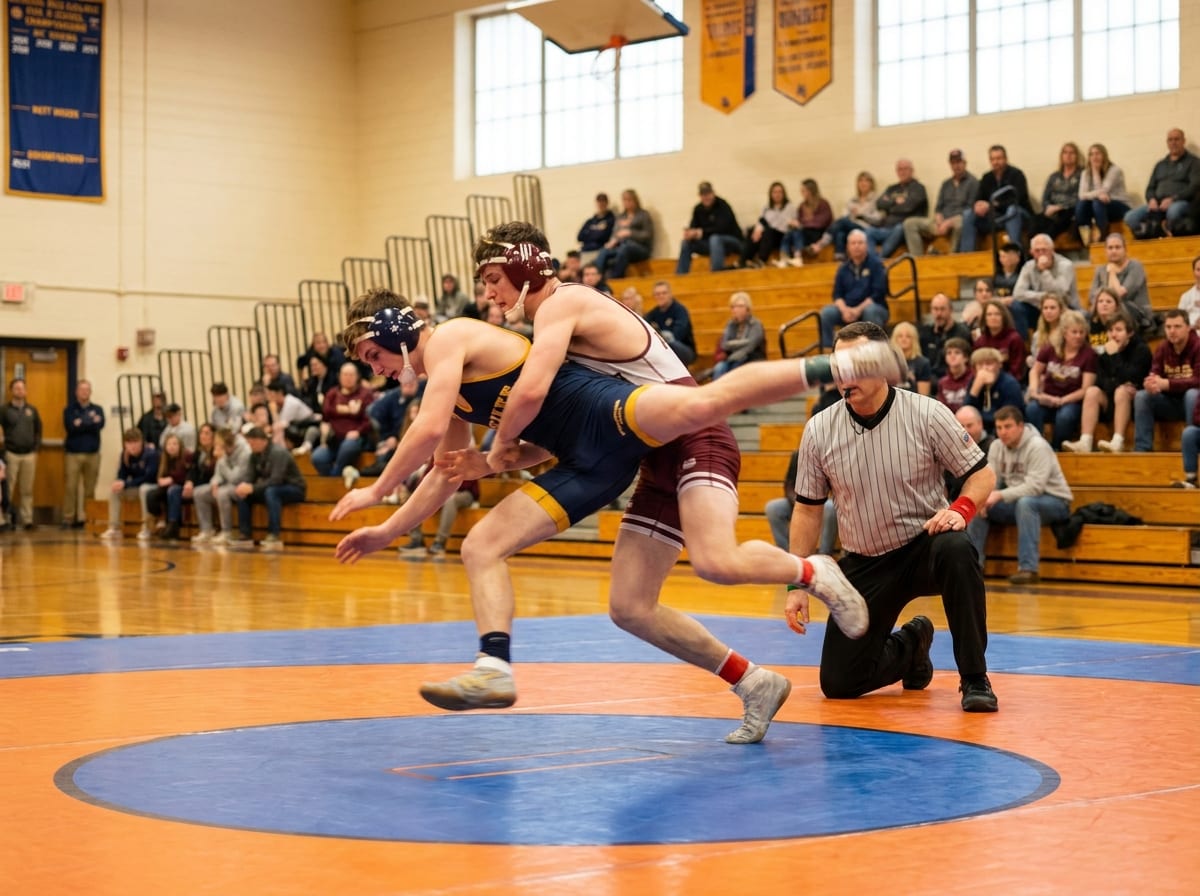
A wrestling tournament does not require a dedicated wrestling arena. It requires large, open floor space that can accommodate multiple competition mats simultaneously, along with warm-up areas, weigh-in rooms, and spectator seating.
The same multi-court gymnasium that hosts basketball and volleyball tournaments during other weekends converts to wrestling configuration by clearing the court equipment and laying competition mats. A gymnasium with four regulation basketball courts can typically accommodate six to eight wrestling mats, which is enough to run a competitive invitational or regional qualifier.
This convertibility is one of the strongest arguments for multi-court design in a recreation center. The same facility generates basketball tournament revenue one weekend, volleyball the next, wrestling the following month, and pickleball year-round on dedicated courts. Each sport brings a different audience, a different travel pattern, and a different seasonal window. Together, they fill the facility's calendar and diversify its revenue base in ways that any single sport cannot.
The proposed Twin Falls recreation center includes four regulation basketball courts with tournament hosting capacity. That same space is what makes wrestling tournament hosting possible without any additional construction.
What Twin Falls is currently exporting
Every wrestling invitational, regional qualifier, and club tournament that Magic Valley wrestlers participate in happens in another city. The hotel rooms are booked in Boise, Pocatello, or Nampa. The restaurant meals are eaten there. The gas is purchased there. The retail spending stays there.
For Twin Falls families with wrestlers, this means paying not only for the sport itself but for the travel costs of competing in it. For Twin Falls businesses, it means watching that spending leave the Magic Valley every weekend from November through February.
The pattern is the same one documented across basketball, volleyball, and pickleball: Twin Falls exports its athletes and imports none. A facility capable of hosting wrestling tournaments would reverse a portion of that flow, bringing visiting teams and families into the Magic Valley during the months when local businesses need them most.
Where the conversation stands
A recreation center committee within the Twin Falls Parks and Recreation Department has been studying this question since 2017. In June 2025, the City Council voted to advance the long-stalled feasibility study. Parks and Recreation Director Wendy Davis said the council's vote "breathed a little bit of life into what I thought was a dying initiative."
A grassroots advocacy campaign has proposed naming a potential facility after U.S. Army Specialist Troy Carlin Linden, a soldier with the 54th Engineer Battalion who was killed in action on July 8, 2006, in Ar Ramadi, Iraq. The proposal comes from a Twin Falls resident who served in the same unit.
Closing
Wrestling is not a sport that needs to prove its relevance in Idaho. It is woven into the state's high school athletic culture in a way that few other sports match. Both boys and girls participation are at all-time highs nationally, and Idaho has been at the forefront of girls wrestling's expansion since sanctioning its first state tournament in 2022.
What Twin Falls lacks is not interest, athletes, or coaching. It is the venue. A multi-court recreation center capable of hosting wrestling tournaments would generate documented economic activity during the winter months when the city's hospitality industry is quietest, when outdoor recreation is offline, and when every other comparable Idaho city is already hosting the events that Twin Falls currently sends its athletes to.
The mats are ready. The wrestlers are ready. The facility is the missing piece.
Frequently Asked Questions
How popular is wrestling at the high school level? Boys high school wrestling set an all-time record with 300,214 participants in 2024-25, making it the sixth most popular boys sport nationally. Girls wrestling topped 74,000 for the first time, growing 102 percent since 2021-22. Both are at historic highs.
How much do wrestling tournaments generate for host cities? Documented examples range from $1 million to $3.74 million. The Indiana state wrestling tournament generated $3.74 million and 2,482 hotel room nights. The Spartan Combat Nationals generated $2.33 million and 4,458 hotel room nights. Missouri's USA Wrestling Championships generated over $1 million and 1,500 hotel room nights.
Does Idaho have a strong wrestling tradition? Yes. The IHSAA sanctions wrestling in four classifications. The state tournament is held at the 12,000-seat Ford Idaho Center Arena in Nampa and is one of the most attended high school events in the state. Girls wrestling received its first IHSAA-sanctioned state tournament in 2022. Programs like Nampa have produced consecutive state champions.
Can a recreation center host wrestling without dedicated wrestling facilities? Yes. Wrestling tournaments use large open floor space with competition mats laid on the gymnasium floor. The same multi-court gymnasium that hosts basketball and volleyball converts to wrestling configuration by clearing court equipment and laying mats. Four basketball courts can typically accommodate six to eight wrestling mats.
Why does the winter timing of wrestling matter for Twin Falls? Wrestling season runs November through February, which is Twin Falls' slowest period for tourism and hospitality. Hotels and restaurants that are busy in summer have capacity to fill in winter. Wrestling tournaments bring visiting families precisely when local businesses need them most.
Is Twin Falls actively considering a recreation center? A city committee has been studying the question since 2017. In June 2025, the City Council voted to advance the feasibility process. No specific site, cost, or funding mechanism has been finalized as of this writing.
Where can residents follow the conversation? Twin Falls City Council meetings are open to the public, and the Parks and Recreation Department posts updates on the city's official website. A community advocacy group is also tracking the issue at twinfallsreccenter.com.