Rec Center
Twin Falls Has Cheerleaders but No Place to Host a Competition
TL;DR:
Competitive spirit is the sixth most popular girls high school sport in America, with 206,262 participants in 2024-25. Twin Falls has cheer programs at both high schools and across the Magic Valley, but no public facility capable of hosting a local competition. A community recreation center can host Saturday cheer and dance tournaments drawing 8 to 15 teams from across southern Idaho, while also running weekly classes, recreational leagues, camps, and showcases throughout the year. It is the only event category in the tournament conversation that serves a 96 percent female participant base, and it uses the facility's gymnasium and multipurpose rooms during hours when court sports are not scheduled.
The tournament hosting conversation for Twin Falls has covered basketball, volleyball, pickleball, wrestling, and indoor soccer. Every one of those is a ball sport or a mat sport scored by points, goals, or pins.
There is an entire category of competitive athletics that operates on a different model: choreographed performance, scored by judges on execution, difficulty, and showmanship. Cheerleading and dance competitions fill recreation center gymnasiums across the country every weekend from September through May. They serve an overwhelmingly female participant base. And they can be hosted at community scale in exactly the kind of facility Twin Falls is considering building.
Twin Falls has cheerleaders. It has dance athletes. What it does not have is a public venue where they can compete locally.
The sport behind the sideline
Most people think of cheerleading as a sideline activity. The participation numbers tell a different story.
The National Federation of State High School Associations reports that competitive spirit reached 206,262 high school participants in 2024-25, a nearly 14 percent increase from the prior year. That makes it the sixth most popular girls high school sport in America, ahead of tennis, cross country, swimming, and lacrosse.
At all levels, USA Cheer reports more than 3.5 million cheerleaders participating nationally. Youth cheerleading participation grew 15 percent from 2018 to 2022, reaching 1.2 million participants under age 14. The number of registered All-Star programs grew from approximately 3,500 in 2015 to more than 5,800 by 2024.
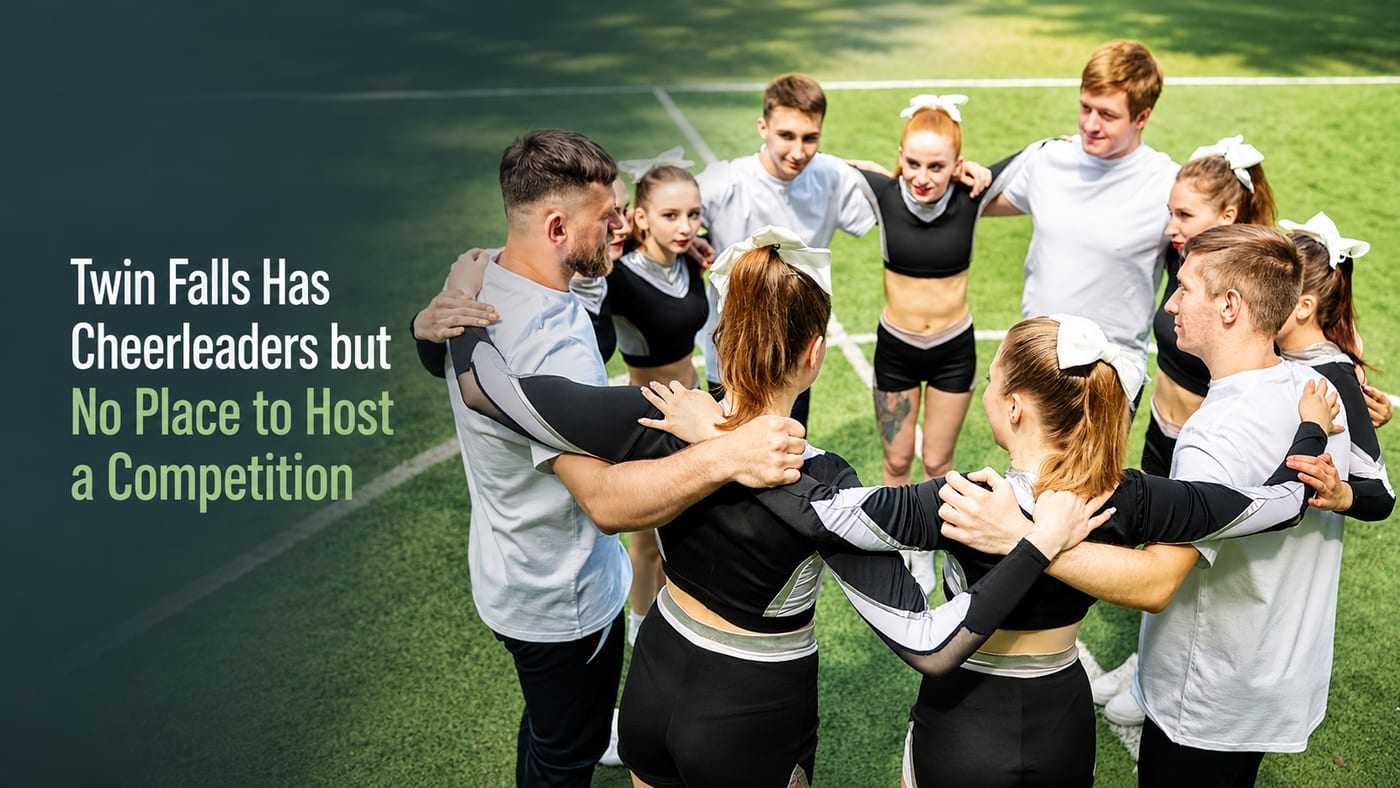
Twin Falls is part of this picture. Both Twin Falls High School and Canyon Ridge High School have cheer programs. Recreational and competitive cheer operates across the Magic Valley through private gyms and community organizations. The athletes exist. The coaches exist. The families exist. The venue does not.
What a rec center cheer tournament looks like
A cheerleading competition at a community recreation center is not the Varsity Nationals in Orlando with 600 teams and 26,000 attendees. It is a Saturday event scaled to the facility and the region.
A typical community-scale cheer and dance competition draws 8 to 15 teams from across southern Idaho. Teams from Twin Falls, Jerome, Burley, Pocatello, Idaho Falls, and surrounding communities register for age and skill divisions. The event runs from morning through late afternoon on a single day.
The format is sequential. Each team takes the gymnasium floor, performs a two-and-a-half-minute routine, and is scored by a panel of judges on execution, difficulty, synchronization, stunting, tumbling, and showmanship. There are no opponents on the floor at the same time. Teams warm up in the multipurpose rooms, stage in a holding area, perform, and then watch other teams from the bleachers. Awards close the day.
A single team brings 15 to 25 athletes plus parents, siblings, coaches, and choreographers. A 12-team Saturday competition draws 500 to 900 total visitors to the facility. Teams traveling from outside Twin Falls need meals, gas, and in some cases hotel rooms for Friday night. The spending is modest compared to a 300-team national event, but it is real, it is recurring, and it flows into Twin Falls businesses on weekends when the facility would otherwise sit quieter.
The proposed Twin Falls recreation center includes a multi-court gymnasium and multipurpose rooms with event space. That combination is exactly what a community cheer and dance competition requires: the gymnasium serves as the competition floor with bleacher seating, and the multipurpose rooms serve as warm-up, rehearsal, and staging areas. No specialized construction is needed beyond what the facility plan already provides.
A demographic no other tournament sport serves
Approximately 96 percent of cheerleaders are female. That single fact changes what hosting cheer and dance competitions means for the Twin Falls rec center conversation.
Basketball tournaments skew male at the youth level. Wrestling is predominantly male. Futsal draws from the broader soccer community. Pickleball is multi-generational but gender-balanced. Volleyball is the only sport in the tournament series that primarily serves girls, and even volleyball shares court time with basketball.
Cheer and dance competitions bring an overwhelmingly female participant base into the facility on event weekends. For a recreation center that aims to serve the full community, hosting events that center girls and young women in performance athletics is not a secondary consideration. It is a direct measure of whether the facility's event calendar reflects who actually lives in Twin Falls.
Demographic data also shows notable diversity within cheerleading: African American females represent 25 percent of high school cheerleaders and Hispanic/Latina participants make up 18 percent, both above their respective national population percentages. Cheer and dance competitions draw a broader cross-section than many individual sports.
More than tournaments: what fills the rest of the calendar
Community cheer and dance competitions might happen six to ten Saturdays per year. The programming that supports those events, and generates facility revenue the rest of the time, runs year-round.
Weekly classes and recreational leagues. Youth cheer classes for ages 4 through 14, grouped by age and skill level. Kids learn tumbling, jumps, chants, dance fundamentals, and teamwork in affordable multi-week sessions. Recreational leagues give girls a team experience with a one-or-two-evening-per-week commitment, a fraction of the time and cost of private All-Star programs. Dance classes across styles, including hip-hop, jazz, contemporary, and creative movement for younger children, round out the weekly schedule.
Camps and clinics during school breaks. Week-long cheer and dance camps during summer, spring, and winter breaks fill the same programming gap that parents feel every time school lets out. These are intensive but fun, designed for exposure and skill-building rather than competitive pressure.
End-of-session showcases. The natural culmination of a cheer or dance session is a performance for families in the gymnasium. These are community events, not scored competitions. Kids perform what they have learned, families fill the bleachers, and the facility generates the kind of civic energy it was built for.
Private event hosting. Cheer gyms and dance studios that need additional floor space for choreography sessions, team rehearsals, or parent showcases can rent the gymnasium or multipurpose rooms. This generates facility rental revenue during off-peak hours.
This programming feeds the tournament calendar directly. Recreation center cheer and dance classes produce teams. Those teams need somewhere local to compete. The rec center hosts the competition. The cycle sustains itself in the same way that recreation center basketball leagues feed into weekend basketball tournaments.
The affordability bridge
The cost difference between private cheer instruction and recreation center programming matters for who gets to participate.
A season at a private All-Star gym runs $3,000 to $7,000 per athlete before travel costs. A multi-week session at a recreation center cheer class typically runs $30 to $60. That is not a marginal difference. It determines which girls in Twin Falls get to try the sport and which are told, by the price tag, that it is not for them.
The Aspen Institute has documented that the income gap in youth sports participation widened to 20.2 percentage points in 2024. Recreation center programming narrows that gap by providing a public, affordable entry point. A girl who starts in a $40 rec center cheer class may eventually move to a competitive All-Star program if she wants to and her family can afford it. But without that starting point, she never discovers the sport at all.
Nampa's recreation center has offered affordable youth programming as part of its self-sustaining revenue model for more than thirty years. Cheer and dance classes fit naturally within that model: they generate program fee revenue for the facility while keeping participation accessible for families at every income level.
The calendar fit
Cheer and dance competition season runs roughly September through May, with peak event weekends concentrated from January through April. That window overlaps with and extends beyond basketball and wrestling seasons, filling the facility's event calendar during the winter and spring months when outdoor recreation is offline.
Weekly classes and camps fill weekday hours and school breaks year-round. Showcases and small competitions fill Saturdays. The programming does not compete with court sports for time. It fills the gaps between them, using the gymnasium and multipurpose rooms during hours when basketball, volleyball, and pickleball are not scheduled.
This is the cumulative facility utilization argument the tournament series has been building: a recreation center that hosts basketball, volleyball, wrestling, futsal, pickleball, and cheer and dance across different days, different weekends, and different seasons operates at high capacity twelve months a year. That diversification is what makes a facility financially sustainable for decades.
Where the conversation stands
A recreation center committee within the Twin Falls Parks and Recreation Department has been studying this question since 2017. In June 2025, the City Council voted to advance the long-stalled feasibility study. Parks and Recreation Director Wendy Davis said the council's vote "breathed a little bit of life into what I thought was a dying initiative."
A grassroots advocacy campaign has proposed naming a potential facility after U.S. Army Specialist Troy Carlin Linden, a soldier with the 54th Engineer Battalion who was killed in action on July 8, 2006, in Ar Ramadi, Iraq. The proposal comes from a Twin Falls resident who served in the same unit.
Closing
Cheerleading and dance competitions are the only performance athletics category in the Twin Falls tournament conversation. They serve a 96 percent female participant base. They draw from a national pool of 3.5 million athletes. And they can be hosted at community scale in exactly the kind of gymnasium and multipurpose space the proposed recreation center already includes.
For the girls and young women of Twin Falls who train in private gyms and travel to compete in other cities, a recreation center capable of hosting local competitions would change what event weekends look like. For the girls whose families cannot afford private instruction, the rec center's affordable classes and leagues would provide the entry point that currently does not exist. And for a facility managing a year-round event calendar, cheer and dance adds another sport, another audience, and another set of weekends to a schedule already built around basketball, volleyball, wrestling, futsal, and pickleball.
The athletes are here. The demand is here. The facility is not. That is the same story every sport in this series has told, and for the girls of Twin Falls, it is past time their sport was part of the conversation.
Frequently Asked Questions
What does a rec center cheerleading tournament look like? A community-scale competition draws 8 to 15 teams from across southern Idaho for a Saturday event. Teams perform choreographed routines scored by judges in age and skill divisions. The gymnasium serves as the competition floor and multipurpose rooms serve as warm-up and staging areas. Total attendance typically ranges from 500 to 900 visitors.
What other cheer and dance programming would a rec center offer? Weekly youth cheer classes, recreational cheer leagues, dance classes across multiple styles, cheer and dance camps during school breaks, end-of-session showcases for families, and facility rentals for private studios needing additional rehearsal space.
How much does rec center cheer cost compared to private gyms? Recreation center cheer classes typically cost $30 to $60 for a multi-week session. A season at a private All-Star gym costs $3,000 to $7,000 per athlete before travel. The rec center model is designed for accessibility and entry-level participation.
Is cheerleading really that popular? Yes. Competitive spirit reached 206,262 high school participants in 2024-25, the sixth most popular girls sport. USA Cheer reports 3.5 million cheerleaders at all levels nationally and 1.2 million participants under age 14.
Would cheer and dance programming compete with court sports for gym time? No. Cheer and dance classes, rehearsals, and competitions fill gaps in the facility schedule between court sports programming. The gymnasium and multipurpose rooms are used during hours and days when basketball, volleyball, and pickleball are not scheduled.
Is Twin Falls actively considering a recreation center? A city committee has been studying the question since 2017. In June 2025, the City Council voted to advance the feasibility process. No specific site, cost, or funding mechanism has been finalized as of this writing.
Where can residents follow the conversation? Twin Falls City Council meetings are open to the public, and the Parks and Recreation Department posts updates on the city's official website. A community advocacy group is also tracking the issue at twinfallsreccenter.com.